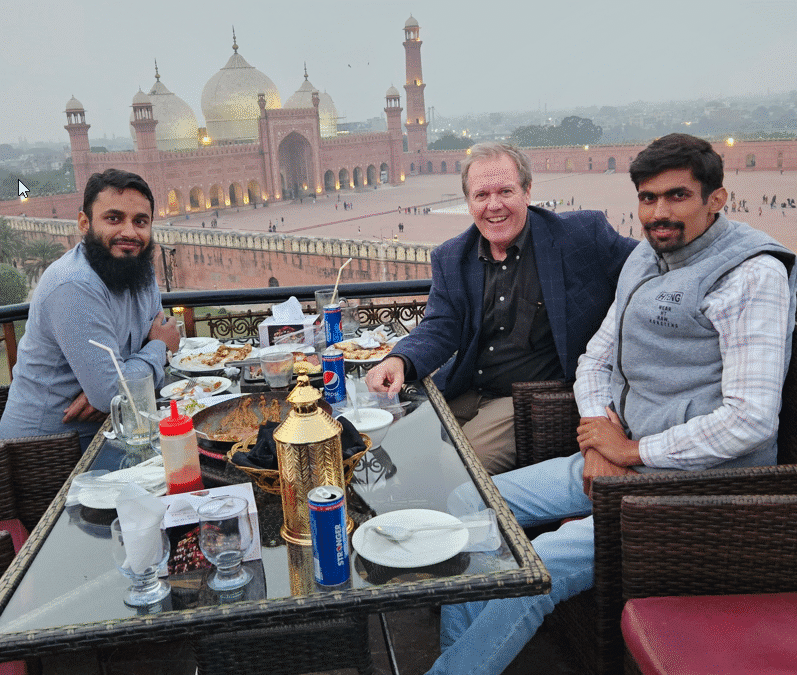
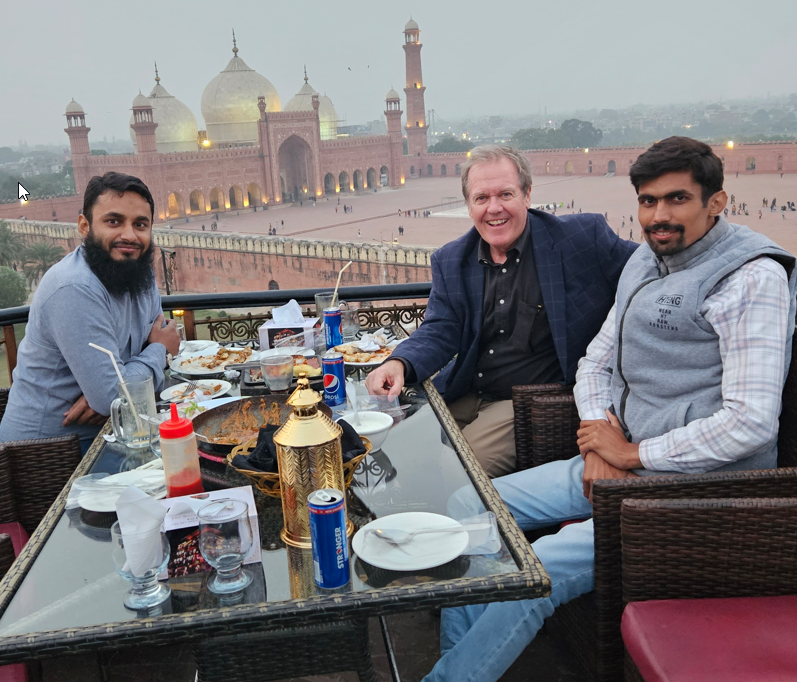
Meet Hafiz (L) and Hammad (R), two amazing young men who I now call family. I spent an incredible week with them in Pakistan. Here we are dining with Lahore, Pakistan’s world-famous 350-year-old Badshahi Mosque in the background.
My family is a bit unusual, and not just because my wife says she’s married to a humor writer with the maturity of a 13-year-old (on a good day, anyway). No, what I mean by “unusual” is that I am the only native-born American in my nuclear family. My wife is from Canada. And we adopted both of our now-adult daughters from China when they were infants.
But many people may not know that in the past few years, my family became even more international. That’s because I have also two nephews from Pakistan. Okay, technically, they are not blood-related to me. But these two fine young men are absolutely part of my forever family. Their names are Hafiz (age 32) and Hammad (28).
Let me back up and explain. Back in 2020, I discovered Hafiz while doing an internet search for a video editor for my YouTube channel, View from the Bleachers. I needed help editing, adding background images, inserting photos, captions, and sound effects. I stumbled onto the profile of a young man from Lahore, Pakistan named Hafiz Ramzan. I had never heard of Lahore. A quick Google search informed me that Hafiz lived literally on the opposite side of the world – 12 time zones away.
After a few months collaborating on my YouTube channel, Hafiz had the idea for us to co-host a series of educational videos called Across the World. The premise was that I would interview Hafiz about life in Pakistan, and he’d interview me about life in the USA. In the process of this collaboration, Hafiz introduced me to his close friend, Hammad Hassan, who took over the role of conducting these Across the World video interviews with me.
Over several months, I learned more and more about these two intriguing young men and their fascinating culture. They are both devout Muslims. Both were university educated. Hafiz was more gregarious and entrepreneurial. Hammad was more introverted and soft-spoken.
As they became more comfortable with this American senior citizen whose life story had almost nothing in common with theirs, Hafiz and Hammad started opening up more with me. I learned that Hafiz had lost both his parents by the age of five and lived in an orphanage from age five through fourteen. I learned that both Hammad’s parents were university educated.
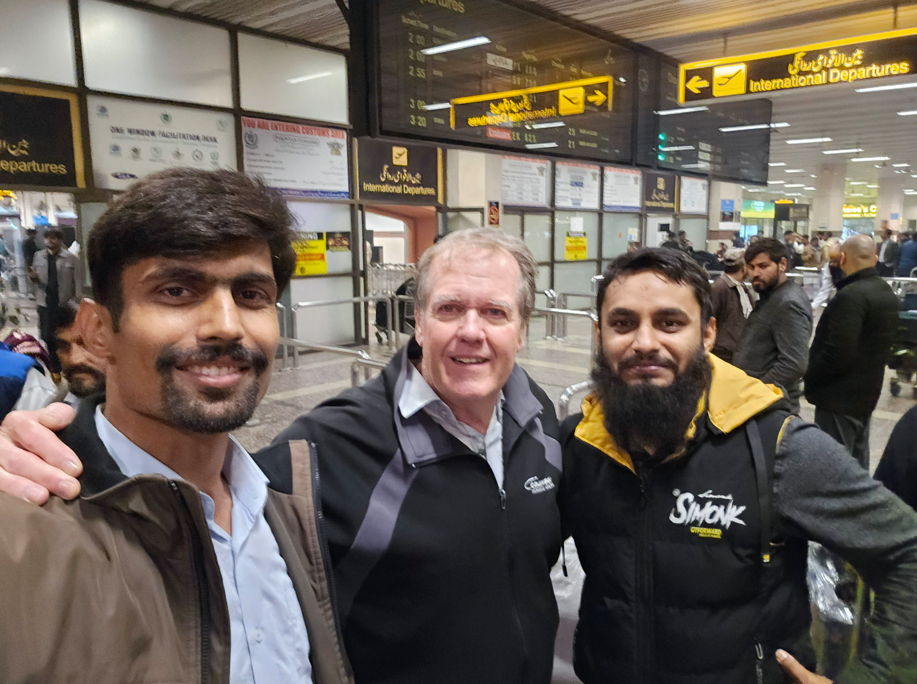
I explained to H and H that in America, when we pose for photos, we put our arms around each other and smile. I said, “This is an American pose.” After a couple days, when someone took our photo, Hafiz would remind Hammad, “Let’s do an American pose.”
Hafiz opened up about some of the worries and frustrations of being the parent of two very young, high-spirited toddlers. He is a deeply loving father. Hammad expressed his interest in getting married and even asked me for marriage advice. I told him to forget about the young woman in Glasgow, Scotland. Long story.
Eventually, Hafiz brought up the idea of meeting in person. It did not take long before I learned it would be almost impossible for a young, Muslim Pakistani male to get a travel visa to the United States. Too many red flags. The US Government would be suspicious of their intentions. The Pakistani government would fear they may leave and never return. I eventually realized that the only way we’d ever meet was for me to travel to Pakistan.
So, in late November 2023, I flew to Lahore, Pakistan to meet them. Lahore is a city of over 12 million people – more people than the combined population of New York and Los Angeles. After a 30-hour journey with a layover in Istanbul, finally at 5:05am in the morning, two days after I began my trip, I arrived at the Lahore International Airport. Exhausted and groggy, I worked my way to the arrivals gate. Once there, I could not believe my eyes. I stared out at a sea of unfamiliar faces – easily two thousand people – all with black hair, dark complexions, all the men with beards (as is the custom of Muslim men in Pakistan). I worried, “How in the world will I ever find my friends?”
Like a lost puppy, I searched in vain for several minutes for a familiar face. Then, from the crowd, I heard a distant voice shout, “Teem! (That’s how Hafiz pronounced my name.) Teem! Over here!” It was Hafiz, and right next to him, Hammad. I rushed over to meet my friends for the first time since I had met Hafiz via the Internet more than three years prior.
Even though my actual birthday was not for another month, Hafiz (center) and Hammad threw a surprise birthday party for me in my hotel room, complete with a birthday cake, balloons, and a tennis racquet as a gift. Notice how they are doing a real American pose, with the hugs and smiles.
In Pakistan, adult men do not hug other men unless they are family. But the moment I saw them, I gave them both what I later explained to them was an American-style hug. I suspect my bear hug startled them a bit. The day we had been waiting for, for three years, had finally arrived. Then in the airport parking lot, the Uber driver Hafiz had reserved could not get his car to start. Welcome to Pakistan.
If you would like to learn about the week I spent in Pakistan, you can watch a video of a talk I gave about my experience. On my first evening there, Hafiz invited me to dinner at his home – something that is virtually never done unless you are family or a longtime close friend. I even met his wife, albeit covered from head to toe in a burka, with only her eyes peering out through the small slit.
A couple days later, I was invited to Hammad’s uncle’s house. It was there I met his father, who had traveled three hours just to meet me. His father did not speak English. I didn’t speak Urdu. And Pakistani men don’t smile a lot around people they don’t know. And for sure they don’t hug other men (other than family). So, imagine my surprise when at the end of our two-hour visit, as I was saying goodbye in my fractured Urdu, I extended my hand to shake hands with Hammad’s father. Instead, he greeted me with a hug. I told Hammad this and he said, “my father is telling you, with that hug, that you are family.”
I am not a religious person. Hammad and Hafiz pray to Allah five times a day. I was over twice their age. But these two young men treated me with abundant kindness and respect the entire time. Whenever we walked through a door, they insisted on holding the door and letting me go first. Respect for your elders is important in Pakistan.
At the end of my brief trip, I realized that Hafiz and Hammad – like most people in Pakistan – seek the same things in life that any of us desire: happiness, safety and security for their family, and a life of opportunity for their children.
L to R: Hammad, me, Hafiz. This is the final photo we took, as I was leaving them at the Lahore, PK Airport to head home. It was a very emotional moment for me to say goodbye, not knowing when I might ever see them again.
Over the past five years, we have become very close. They call me Uncle Tim (which I love, I must say). I refer to them as my nephews. We do What’s App video calls at least twice a month now.
Our cultures and our everyday lives could not be more different. The roles of men and women in Pakistani culture are very different from America. Most marriages are arranged by the parents. The sounds, smells, and images of their world have few parallels to mine. And yet, the more time I spend talking with my nephews, the more convinced I am that our similarities far outweigh our differences. And the closer our familial bond has become.
One thing I know for a certainty. These two young men will forever be a part of my family. I’m still trying to find a way to help them get travel Visas to come visit America someday. For now, they remain across the world, 7,000 miles away. But they will always be right beside me, in my heart. – TEJ
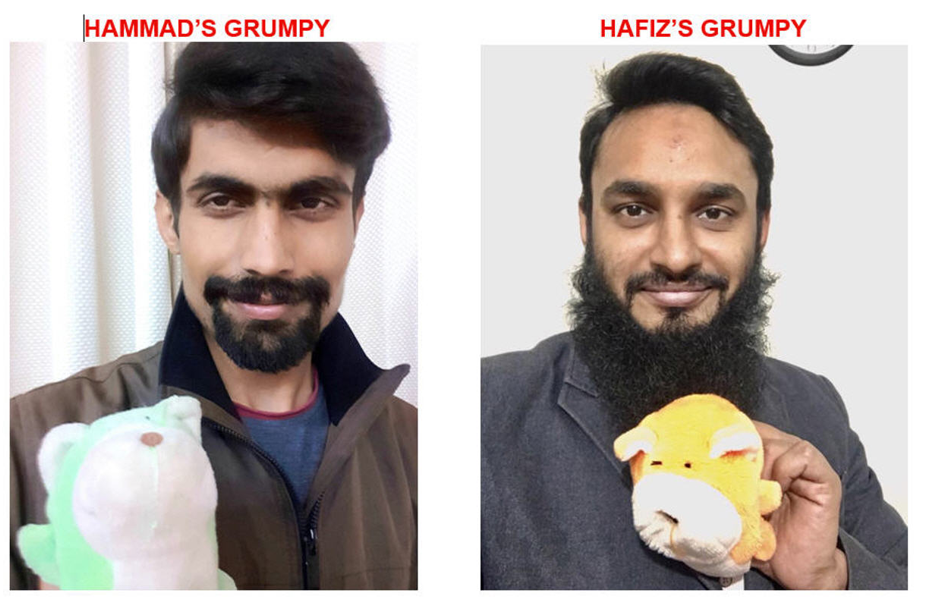
[Postscript: For the past forty years, whenever I travel internationally, I take my trusty softball-sized teddy bear called Grumpy along for the ride. Pakistan was no exception. I have even written about my extensive Travels with Grumpy. It turned out that both Hammad and Hafiz LOVED playing with Grumpy. He became a source of endless entertainment for them.
When I returned home, I noticed I still had two of Grumpy’s best friends (Yellow Grumpy and Green Grumpy), which I had bought the same time I purchased my main (brown) Grumpy, back in 1981. They had sat quietly by my desk, next to my main Grumpy for over 40 years.
So, I decided, hey, why not send one Grumpy to each of them? Both Grumpies arrived exactly one month later, on the very same day. Hammad and Hafiz both sent me photos of themselves (above) holding their own Grumpies. Hammad is now in the UK, where he recently completed a master’s program in business and just got engaged. And he made sure to bring his Grumpy on his UK adventure for companionship. – TEJ]
PS: If you enjoyed this week’s post, let me know by posting a comment, giving it a Likeor sharing this post on Facebook.
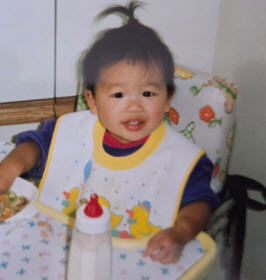
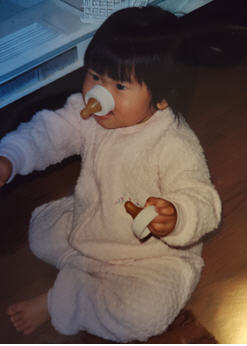
Little Yong Li, around age 1. Little did she know what challenges her life would have in store for her.
She was found on a busy street corner in a city of over four million people. She was only a few days old – abandoned, lost, completely unknown. No identification on her to indicate whose family she belonged to. An orphan, a tiny baby whose first meaningful life experience was to be abandoned by her parents for no other reason than the misfortune of having been born a girl. Such was the fate of hundreds of thousands of baby girls in China between 1979 and 2015.
The orphanage where she was taken, thankfully, was a good one. The staff gave her the name Yong Li, which meant “Forever Beautiful.” Despite her tumultuous beginning, in less than five months, little Yong Li would be matched to a childless couple in America and headed to her new forever home in the States.
Yong Li overcame her traumatic origin and would eventually thrive. But like many young Chinese adoptees in English-speaking countries, she had serious speech challenges, struggling to pronounce many sounds that she’d never heard during her brief time in China – sounds like the letters R, S, and T. For several years as a young child, her parents had her take speech therapy classes.
Nervous about entering Kindergarten, she overcame her anxieties and in time settled into school life. A relatively shy child, Yong Li learned to play chess at a young age. Some of her favorite times were the quiet moments she would play chess with her dad. Over her first 12 years, she became even more introverted. She didn’t have many friends. But she discovered the joy of the wizarding world of Harry Potter and would spend hours upon hours reading one Harry Potter book after the next.
As she reached her early teen years, she became a bit of a tomboy and excelled at sports, especially soccer. She was a fierce competitor, playing defense. Always the shortest girl on every soccer team, Yong Li was also her team’s fiercest competitor. It did not matter the size or physicality of her opponent. If they had the ball, it wasn’t going to be theirs for long.
Yong Li doing what she loved more than anything as a teenager: soccer. She was not very big, but wow, could she play the game with passion.
Soccer became her passion. Unfortunately, Yong Li’s fearless, overly aggressive style of play came at a steep price. She suffered a series of minor concussions playing the sport she loved. One time she and an opposing player collided heads when they both went to head the ball. Concussions, her parents would learn, tend to be cumulative, meaning the effects of multiple concussions over time are more severe and long-lasting than the effects of a single concussion, thus leading to a build-up of cognitive damage and persistent symptoms.
Finally, a soccer collision in the spring of her junior year of high school was so severe that Yong Li was forced to take a medical withdrawal from school for the rest of the school year. This would be the last soccer game she would ever play. It crushed her spirit. On top of that, she had to attend full-time summer school to retake her spring semester in order to graduate on time. Doctors told her she could never play any contact sport ever again. The risk to her long-term mental and physical health was just too great.
Despite the upsetting setback, Yong Li would go on to university. But in the spring of her sophomore year, she slipped and banged her head on a wall pipe in her dorm. The brain injury was so serious that for the second time in three years, she was forced to take a medical withdrawal from school. Somehow, thanks to her stubborn determination, Yong Li overcame this latest misfortune and completed her nursing school education, graduating Magna Cum Laude.
Yong Li began her career as a cardiology nurse. After a few years, she decided to pursue a DNP (Doctor of Nursing Practice) program to become a Nurse Practitioner. While going to grad school part-time and working full-time, one day she was working with a difficult patient who was in such an agitated mental state she had to be strapped to her hospital bed. When the patient asked if she could use the bathroom, Yong Li cautiously removed the straps and helped her up out of the bed. Then in a flash, the patient, completely unprovoked, angrily landed a severe blow directly on Yong Li’s temple with her fist. Yong Li fell hard, smashing her head forcefully into the hard linoleum floor. She briefly lost consciousness.
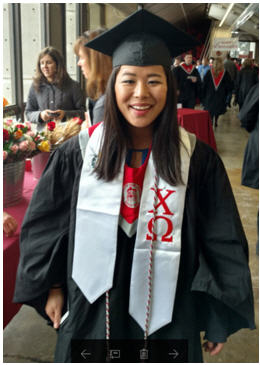
Yong Li on her graduation day from Nursing School.
This time, her traumatic brain injury was so extensive that Yong Li could barely speak or even open her eyes for days. When she tried to talk, her words came out so slurred she sounded like she was drunk. She could not concentrate at all. She couldn’t conduct even a short conversation because it hurt her brain too much.
She had to undergo intensive therapy of all types – cognitive, speech, balance, psychological, and more – for almost three years. Her cognitive impairment was initially so profound that doctors were doubtful she would ever be able to work in the healthcare field again, let alone become a nurse practitioner. She had to face the stark reality that she might be forced into a future of part-time low-paying jobs because the concept of her working a full eight-hour shift was unthinkable, according to the doctors.
But Yong Li never gave up. She spent just under three years in intensive physical therapy, going to multiple medical appointments most weeks, slowly, painfully regaining her ability to concentrate, communicate, and handle stress. During this grueling period, she was unable to work for almost three years and had to withdraw completely from her graduate program. She came close to losing all her academic credits because so much time had passed.
Eventually, incredibly, she returned to work, albeit only part-time for the first year. But slowly, over time, she was able to increase her hours and return to full-time work. Today she is back working as a full-time nurse and once again pursuing her dreams of becoming a DNP.
After almost three years of watching Yong Li struggle to regain her cognitive function, Yong Li’s doctor told her dad that he was amazed at her progress. “She’s a real fighter.,” he said. “Most people in her situation just give up. It’s too hard, too overwhelming, and too emotionally draining, to keep going. The progress is just so slow, it becomes demoralizing. But she never gave up. She is one tough young woman.”
Yes, she is. Yong Li never gave up. She has always been a fighter. It’s one of the many things that her father always admired about her. And I should know. I’m her dad.
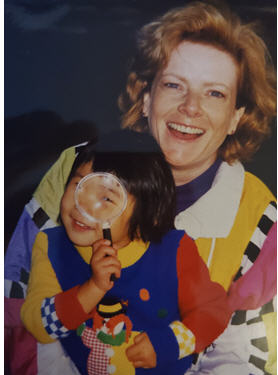
Me with my amazing, resilient young daughter, Yong Li.
PS: If you enjoyed this week’s post, let me know by posting a comment, giving it aLikeorsharing this post on Facebook.
Once upon a time there was a humble family man named Tim. Tim loved the holiday season more than any other time of year – all the traditional songs, twinkling lights, frosted gingerbread cookies – but most of all, seeing the magic of Christmas in his kids’ eyes. Yes, Tim was blessed with two wonderful daughters, Rachel and Emily. He remembered so many wonderful Christmases from their youth with fondness.
However, in recent years, as his girls grew older and more independent, Tim sensed that the holiday spirit was slipping away from their Christmas gatherings. Indeed, this might be the last year that the entire family would be together for the holiday as both girls were busy with their careers in far-away cities. So, Tim made up his mind. He was going to bring back the magic of Christmas one last time!
The holidays were rapidly approaching. Emily arrived home first. Tim was so excited to see his younger daughter. After all, he’d not seen her in six full moons. Tim had a wonderfully festive plan for just the two of them. They would hunt down the perfect tree, a majestic tribute to Father Christmas. Then they’d decorate it with shimmering ornaments and glittering tinsel. But Emily was jet-lagged from her long flight home from China and went straight to bed – for the next two days. So much for that inspiration. Oh, Tannen-bomb, thought Tim.
This is my family (2012 photo). At left is our younger daughter Emily. At right is Rachel (older by one year). The guy next to Michele, attempting to hide their receding hairline, would be me.
My wife Michele is originally from Toronto, Canada. I was born in Albany, NY. Somehow, through an odd circumstance of good fortune, we ended up moving to Seattle in 1991. (But that’s a story for another time). We are adoptive parents of two high-spirited daughters, Rachel and Emily. I often tell people Rachel is the greatest Christmas gift I ever received, while Emily is the greatest birthday present I ever received. I will explain why in this story about how our rather international family came to be.
When we began thinking about starting a family, we eventually learned we would be unable to have biological children. While for some couples, this is a source of tremendous grief and loss, I never felt that way. To me, it just meant we would start our family in a different, admittedly unexpected way – through adoption.
We eventually decided to adopt from China – in part because we had read that each year there were tens of thousands of children without families – mostly girls – that were forced to grow up in orphanages. And conditions in these orphanages varied greatly from city to city. China required the adoptive parents to travel to China (unlike some nations where the babies are flown to the states to meet their new parents). We would be required to spend roughly ten days in China to complete the adoption and get approval to leave the country with our new baby. We had no idea what to expect.
We quickly let go of the notion that our child might have blue eyes, reddish hair, and freckles. But still, it was more than a little surreal to think that many thousands of miles away in a city we’d never heard of, there would be a tiny, four-month old baby who was somehow destined to become our daughter. And then, twelve months later, we would fly to China to adopt a second baby to complete our family.
Our daughters, Rachel (now 28) and Emily (27) will someday tell their own adoption stories. But this is how I experienced it. In the late 1970s, China adopted a one-child policy. The rationale was to reduce the growth rate of China’s enormous population. (China discontinued this policy in 2016.)
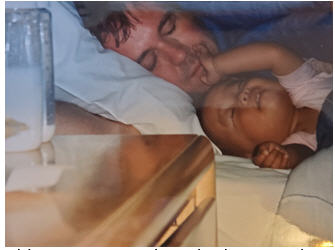
This is a photo from our very first evening with Rachel – while we were still in China. At first, Rachel protested vociferously against going to sleep. I quickly learned to pat the bed next to her in a constant thumping sound, which soothed and quieted her down.
In rural China, the tradition going back 5,000 years was for young couples to move to be near the husband’s family and take care of his parents when they grew old. As a result, in rural China, if you could only have one child, it made economic sense to prefer having a son over a daughter, so you’d have someone to take care of you in your old age. It was a form of social security throughout most of China.
An unfortunate result of this one-child policy was that every year, for decades, thousands of baby girls were abandoned (or worse) – often placed in early morning hours outside of a government building, in the hopes they would be quickly rescued and taken to an orphanage.
In August 1994, we began the paperwork to adopt. About the same time we submitted our application, a tiny baby girl, later given the name of Yong Li by the orphanage, was born in a rural village in southwestern China outside of the city of Kunming. A few months later, we were matched with her and assigned a travel date to fly to China: Christmas day.
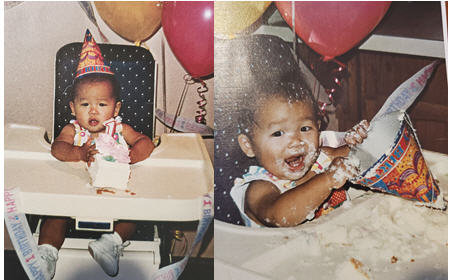
As a toddler, Rachel loved food – especially playing with it. On her 1st birthday, she tried a piece of birthday cake for the very first time. At left, she is contemplating what exactly to do with her cake. At right, Rachel about ten minutes later, having annihilated the cake.
But our adoption almost fell apart the night before we would leave for China. We were planning to travel with Michele’s mother. We celebrated the holiday the night before, at my brother Bob’s house. Because I had arrived at Bob’s house from work, we had taken separate cars, with Michele and her mom driving to Bob’s house from home.
Around 9pm, I arrived home before Michele and her mom. I saw that the answering machine had a message. It was from Bob: “Tim, go to Evergreen Hospital as soon as you can. Michele and her mom have been involved in a very bad car accident. They’re in the hospital. I don’t know how serious it is.”
I drove to the hospital with competing anxious thoughts racing through my mind: How badly were they hurt? Would they both be okay? What would happen to our plans to fly to China? Would we lose this baby? Would I be flying there on my own? Once at the hospital, I learned that Michele was okay – badly shaken, but okay. Her mom was badly bruised, but no broken ribs. The car was a total loss. But they were cleared by the doctor to fly to China – barely.
We got to the airport on Christmas morning. Michele’s mom required wheelchair assistance in order to board the plane. We arrived in Kunming in Yunnan province and filled out the first of what would be many rounds of paperwork. The next day, they brought us, along with three other couples, to the orphanage where little Yong Li had been since she was born in late August.
Emmy loved to play with the most unusual toys. She decided to try this new fashion statement, and I think she figured out she was being funny, because Michele and I laughed out loud.
When they presented a little baby girl to us, Michele and I were confused and concerned. The baby they gave us, Michele knew, was NOT our baby – based on the one photo we had previously been given. She handed the baby back and told the orphanage staff person, “That’s not our baby. Can you please look for our baby?”
A few minutes later, our facilitator came with another baby. And we knew in an instant this was little Yong Li. We kept her Chinese name as part of her name, because it meant “forever beautiful” and because we felt it would be a way to remind her of her Chinese heritage.
The moment I first held our four-month old baby in my arms I fell in love. I knew in that instant that I could not possibly love a child more than I loved this little baby. She didn’t look anything like me. I didn’t care. I am convinced to this day, she was destined to be our daughter. I bonded with her in a heartbeat. Then she threw up violently all over my clothes. That’s when I learned about the need to pat a baby’s back after she’s consumed formula.
I thought about how terrifying this whole ordeal must have been for this tiny infant. We didn’t look, smell or talk like anyone she had ever seen. Here we were, two complete strangers ripping her from the only world she had ever known. Then we would whisk her thousands of miles away to a world she knew nothing about. She had no say in any of this. She had to be feeling some level of panic.
We always knew we wanted to adopt a second baby from China. We’d probably wait three years, like many families do between kids. But in the ensuing months, we read news stories that China was preparing to close international adoptions to the United States, in part due to some negative news coverage in the US about Chinese orphanages. Concerned that the door might close forever, we accelerated our plans and filed an application to adopt a second child who we were pretty sure would be another girl. We would name her Emily.
By the time she reached pre-school, Emily overcame her introversion and blossomed into a very outgoing, energetic person. She was always very short for her age, so other kids liked to carry her around like a doll.
When we were approved, we were matched with a baby girl, estimated to be around 3 months of age at the time (but it’s just an estimate – they rarely know the actual birthdate of these babies – unless someone pins a note to their clothing). We were assigned a travel date of January 10, 1996 – my birthday. Ours would be the second to last group of American families permitted to adopt from China, before they closed the door on adoptions with the USA for several years.
We flew to Nanchang, in the province of Jiangxi, China, along with eight other couples. The baby waiting for us was named Jiang Qiu (pronounced “Ji-AHNG Choo”). It meant “Autumn River” (well, technically, “River Autumn”) and we decided we would keep her Chinese name as part of her middle name, like we did for her sister.
When we landed in Nanchang, our facilitator asked us all if we would like to see pictures of our babies. Until that moment, none of us had seen a photo of our matched child. I will always cherish the photo of Emily that they handed to me. In the photo, she had the most intense expression on her face. I remember thinking to myself in that moment, “I have a feeling this little baby is going to be VERY high-spirited.” I had no idea how accurate my prediction would eventually turn out to be.
We were supposed to go to our hotel and get a good night’s sleep before meeting our babies the next day. But then, in the airport parking lot, our facilitator asked, “Would you like to meet your babies tonight?” I distinctly recall thinking to myself, “Um, I really could use one final good night’s sleep” but everyone else shouted, ‘Yes, Yes, Yes!!”
So, we got to our hotel and within minutes, the nine babies were presented, one after another. The very last one called out was “Jiang Qiu” – our baby. She was so tiny – the smallest of the nine infants. And beautiful. Wrapped in five layers of clothing, the outermost layer being a red sweater, which we have kept to this day. Unlike Rachel, who was almost completely bald when we met her, Emily had a full shock of thick black hair.
We had a couple days in Nanchang to go sightseeing. So picture this: nine middle-aged Caucasian couples, walking around, carrying Chinese babies. We stuck out noticeably. We never saw another Caucasian our entire time in this city. I was carrying Emily on my chest. A man wearing a snuggly no doubt must have appeared even more unusual to the local population.
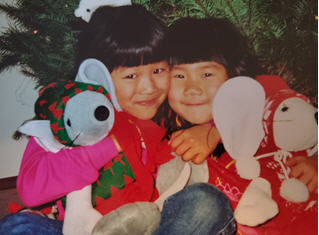
One of the many photos of Rachel (L) and Emily (R) from early childhood. I am guessing they are roughly 5 and 4 in this photo.
Before long, we became a bit of a curiosity for onlookers, especially elderly women, who seemed confused about why all of these white people were walking around carrying Chinese babies. One woman came uncomfortably close to me. She appeared to be scowling in disapproval. Then I presented to her a note, written in Chinese, that I had asked our facilitator to compose. The note read: “We are from America. This little baby girl is an orphan and has no home. We have come to adopt her and give her a forever home.”
Upon reading this note, the woman paused, looked at me, then at Emily, and suddenly her scowl turned into a huge smile. She gave me two enthusiastic thumbs up, then stroked Emily’s cheek gently. She could not speak English any better than I could speak Mandarin. But there was a quiet, unspoken connection, as she nodded, smiled, and showed the note to many of the other dozen women who had gathered around us. All of them started smiling and patting the babies’ cheeks.
By the time we arrived home with Emily, then about four months old, Rachel, almost 17 months old at the time, was thrilled. To her mind, we had brought her back her very own doll to play with. At first Emily was a bit overwhelmed by Rachel’s overpowering personality. But as the months and years went by, Emily stepped out from behind Rachel’s shadow to discover her own equally strong-willed personality.
In their early years with us, every night, we would hold them before putting them down for bed. I would kiss them on the top of their heads and tell them, “I love you to the universe and back.” I have often thought, yes, this is the family I was meant to have.
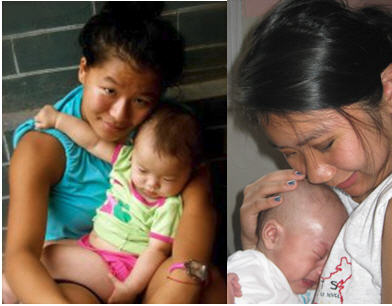
When Rachel (L) was 17 and Emily (R ) was 16, they traveled with Michele to China for three weeks. During that trip they visited three orphanages. It was their first trip back to China. This was, I believe, a life-changing experience for them. The photo of Emily is my single all-time favorite photo ever taken of her.
When Rachel was 17 and Emily was 16, they went back to China with Michele one summer as part of a group of adoptive families that visited several tourist sights of China, including the Forbidden City and the Great Wall. They also spent several days volunteering at three different orphanages. It was a powerful experience for both of them. Both girls told me how heartbreaking it was to have to say goodbye to these innocent children who most likely would never have the kind of lives Rachel and Emily had experienced.
A day does not go by that I don’t stop to reflect on the miracle that is our adoption journey. Like any other parents, we have had our challenges. And we have made our share of parenting mistakes. Both our girls went through the terrible teenage years in which at times, they would cause us many anxious moments and sometimes endless frustration. But both of them made it through those turbulent years and are leading for the most part happy and productive lives. We are deeply proud of both of them.
I often think about their birth parents and the pain and sadness they must have felt – and continue to feel – over having to make the most difficult decision any parent could possibly make – to let their beautiful babies go, for whatever reasons compelled them to do so. If I could wave a wand and make it possible for Rachel and Emily to meet their birth parents I would do it in a heartbeat. I wish I could somehow meet them just to let them know their baby girl found a good home, had a happy childhood, and is deeply loved.
People have said to Michele and me countless times that our two girls are “so lucky to have been adopted by you guys.” But I don’t see it that way. To me, Michele and I are the lucky ones. As we wrote on our adoption announcements: We didn’t give our two daughters the gift of life. But life gave us the gift of them. And they will forever be the greatest gifts Michele and I have ever been blessed to receive.
That’s the view from the bleachers. And no, I’m definitely not off base.
PS: If you enjoyed this week’s post, let me know by posting a comment, giving it a Likeor sharing this post on Facebook.
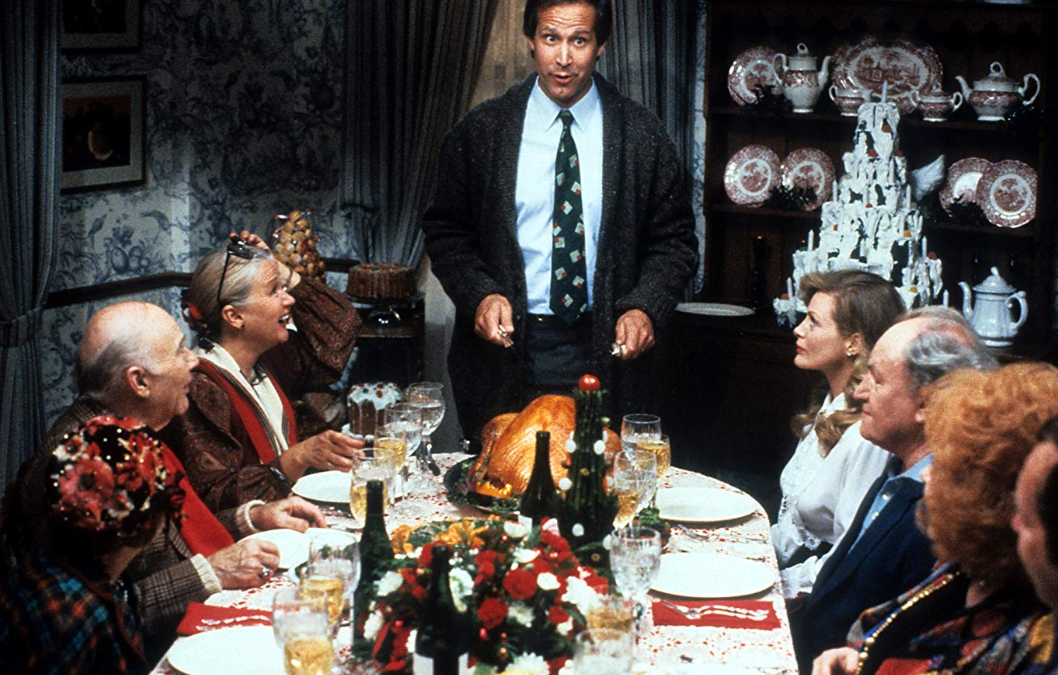
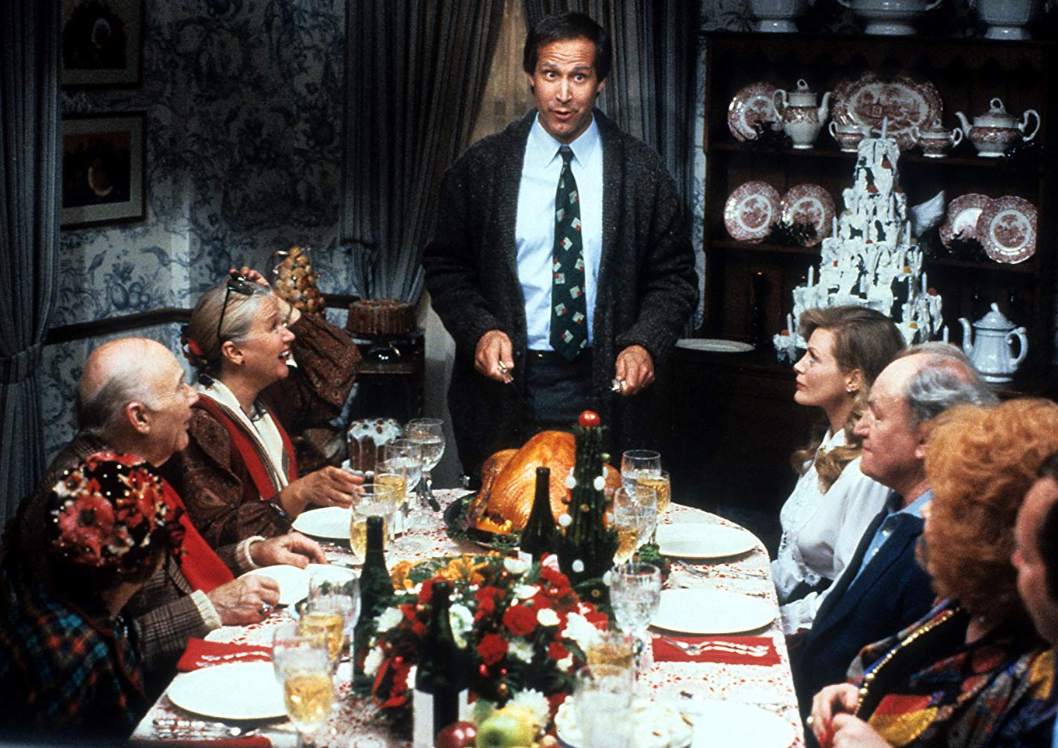
It’s Christmas dinner, a time of giving thanks and sharing good food and stories with your family, and occasionally with some quirky relatives who make things, well, let’s just say, interesting.
The weather is getting colder. The hours of daylight are rapidly waning. And Costco has inflatable eight-foot Snow Globes on sale (although in full disclosure, these went on sale in early September). The holiday season is officially upon us.
An important tradition is the family Christmas dinner with loved ones, and, sometimes with not-so-loved ones, by which I mean your cranky, Fox News-watching, conspiracy-theory-loving Uncle Howard, who announces three days before Christmas that he’ll be joining you for the feast, even though you didn’t actually invite him.
Unfortunately, all too often the sumptuous Christmas repast can be accompanied by heightened tensions as we struggle to avoid getting sucked into a heated argument with relatives who are oblivious of their behavior. If you’re anxious about the impending arrival of Uncle Howard, who will most likely be carrying a half-consumed case of Budweiser, don’t despair. It’s going to be okay. You’ll get through this in one piece, I promise.
When Uncle Howard makes his grand entrance two hours late with Carlotta, his latest practically-prepubescent fling, on his arm, be sure to greet them with a polite hug. Try to ignore their matching red MAGA hats – and the large tabby cat draped around Carlotta’s neck. You might want to lock Otto, your schnauzer, in the basement, lest his very strong prey instinct kick in and he chase the kitty around everyone’s feet.
Remember, above all else, DO NOT BRING UP POLITICS! When Howard snipes, “So, who did you vote for, for president this year?” just smile, say, “There was an election this year? Who knew?” and quickly change the subject.
When all are seated around the festive table, take this opportunity to fan the flames of familial bonding by sharing how your wife has helped you to become a better husband. Well done. You could not possibly have guessed that Howard would use words of harmonious wedded bliss to torch his ex: “Speaking of wives, my ex totally cleaned me out in the divorce. And now she wants my house. Over my dead body…” Okay, maybe you should have foreseen that one. Time to change the subject – again.
I recommend football. What balding senior citizen with a hot young girlfriend doesn’t like to brag about his knowledge of sports. So, you open with, “Hey, looks like another rebuilding year for the Seahawks, eh?” Who knew Howard’s comeback would be, “Nah, pro football has been ruined for me – ever since all those Negroes showed their hatred for America by refusing to stand for our National Anthem.” I know what you’re thinking – did he just say “Negroes?” Bite your tongue.
Okay, so talking sports was a bad idea. You need to find an innocuous topic that no one can argue about. Ah…the weather. Conversation doesn’t get blander than that. You causally mention, “I hear we may get six inches of snow today. Looks like we might have a white Christmas after all.” But to your dismay, Uncle H storms back, “Gonna snow? See, I told you snowflakes that global warming is a hoax. All this hysteria about climate change is just liberal propaganda. I know because Sean Hannity says so.”
Okay, I’ll admit, I didn’t see that one coming either. Still, it’ll be fine. Deep breaths. Deep, deep breaths. Just then, the doorbell rings. Who could that be? To your great surprise, it’s your cousin Claire with her new wife, Monica. “Hey, Couz! We happened to be in the neighborhood and thought we’d stop by. Are we too late for chow?” What could possibly go wrong now?
As the gracious host you are, you welcome your unexpected guests to join in the festivities. Out of left field – or rather, far rightfield – Howard walks up to Monica, smiles and remarks, “Howdy, girls. You know, 90% of lesbians are witches. You’re both gonna burn in Hell. But in the meantime, Merry Christmas. Or do you not celebrate the birth of our savior?” Looking back at you, he smirks, adding, “Or am I required to say, ‘Happy Holidays’ so I don’t offend all your liberal friends’ feelings in their communist War on Christmas?”
One thing that can create some anxiety at Christmas is the arrival of the unexpected relative who’s far more delighted to see you than you are to see them. No worries. What could possibly go wrong?
Somehow you are able to corral everybody back to the dinner table, making last-minute strategic seating alterations. Calm seems to have returned.
You gather everyone in your gaze and suggest each person share what they’re grateful for at this special time of year. You set an excellent example by observing, “I am thankful for my family, our good health, and our lovely home. We are so blessed.” Nice try. Then Uncle Howard chimes in, “I’m thankful Carlotta is way hotter than my nasty ex-wife. And I’m thankful to God for choosing Donald Trump – AGAIN! – to be our greatest president ever. And once his Supreme Court proves the 2020 election was stolen four years ago, he’ll lock up Biden, Obama, and Hillary.”
Things quickly unravel. Everybody starts shouting. Claire angrily hurls a dinner roll that hits Howard smack in the eye. Monica accidentally steps on Carlotta’s cat, which lets out a blood-curdling MEEOOOOWW!!!!. This sets off a barking frenzy by your dog Otto, which startles Grandma, who jumps up from her wheelchair, accidentally knocking over the candelabra, which sets the tablecloth on fire. That activates the sprinkler system, completely ruining your wife’s new dress and expensive coiffure.
Baby Sally starts wailing, which further terrifies the cat, which suddenly hurls itself through the kitchen window, followed by Otto, who you did not know could leap that high. All of which amuses your kids to no end, as they laugh hysterically.
Claire screams something about Howard being a disgusting racist, sexist pig, to which Howard yells back, “At least I won’t burn in hell for being a commie lesbian!” Christmas with the relatives has descended into total pandemonium. When the smoke alarm starts trilling, you merely shake your head as you realize your apple pie in the oven is now burned beyond recognition.
Let’s face it. Despite your best efforts, your family Christmas dinner has turned into a Chernobyl-level meltdown. And that’s not even counting the 150 stitches the cat and dog needed for their acrobatics, smashing through the kitchen window. To avoid another disaster next holiday, I suggest you seriously consider entering the Witness Protection Program, so none of your relatives can locate your address. Sure, that may sound drastic. But it’s either that or listening to Uncle Howard’s tirade at the next family gathering about how the COVID pandemic was a Chinese hoax and how the vaccine was a nefarious plot by Anthony Fauci to kill conservatives with micro-chips.
Good luck. I hear Montana is a nice place to start a new life.
That’s the view from the bleachers. Perhaps I’m off base.
PS: If you enjoyed this week’s post, let me know by posting a comment, giving it a Like or sharing this post on Facebook.



 When I returned home, I noticed I still had two of Grumpy’s best friends (Yellow Grumpy and Green Grumpy), which I had bought the same time I purchased my main (brown) Grumpy, back in 1981. They had sat quietly by my desk, next to my main Grumpy for over 40 years.
 PS: If you enjoyed this week’s post, let me know by posting a comment, giving it a Like or sharing this post on Facebook.