Remember way back when, before you had kids, how you and your spouse would go on romantic getaways to exotic destinations like Cancun or Paris or maybe Santorini? Ah, such relaxing vacations. But then you screwed up everything by deciding to start a family. Oh sure, having young kids doesn’t mean you can no longer go on vacations. It just means you can’t enjoy them.
By the time your kids turn seven, as summer vacation season approaches, they’ll begin the longstanding family ritual: complaining that every other child in the free world has been to Disney World – twice – “except for us! It’s no fair!” This is an excellent time to invite your kids to ask the Millers down the street if they might consider adopting them, since apparently “the Millers are way more fun parents than your mom and me.” I never particularly liked the Millers. I suspect the husband may be a metrosexual. But that’s a story for another post.
As surely as my Seattle Mariners will never win the World Series in my lifetime, it’s an equal certainty that sooner or later, you will buckle under the pressure of the relentless nagging and offer to take your kids to Disney World. And for that you have my deepest sympathy.
A trip to Disney World is the perfect vacation – if you like standing in line for hours at a time in sweltering 96-degree heat with 97% humidity, listening to your young children whining endlessly about how long all the waits for rides are. Usually by about 1pm on Day One you’re starting to seriously regret your decision to spend thousands of dollars that could have been much better spent on a brand new red Camaro instead. If this sounds like your idea of fun, then pack your bags and head to the airport for your very own Disney adventure. Then turn around and go back home. You forgot your four-year old, Ashley. Then strap Ashley and her adorable Disney-branded Lilo and Stitch backpack into her car seat and get ready for a not-so-memorable trip to visit Mickey and his pals.
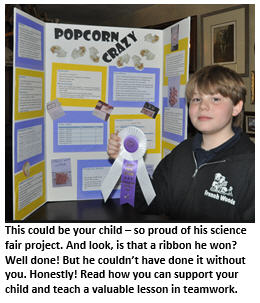
If you have kids, then by the time they reach middle school, it’s a certainty they’ll turn to their parents for help with their science fair project. In our family, they naturally turned to me because they respected my enormous wealth of scientific knowledge [after all, I’ve watched more than two episodes of Nova] – and not at all because my wife has told them “I’ve driven you to 600 soccer practices and 125 piano lessons over the past three years. It’s time your father got off the couch for once. Go ask him!”
Helping your child with his noble science fair project can be a wonderful bonding opportunity – parent and child working together to bring a complex endeavor from inception to completion. Remember, your role is merely to coach, not to take over the project. Use this chance to teach your child a life lesson in taking responsibility. Follow this simple seven-step roadmap, and before you know it, your little wunderkind might learn a lot more than just how many planets are in our solar system (I still say the answer is nine. Pluto rocks).
Step 1: Help your child select a project that’s achievable.
Kids are naturally competitive. They want to impress their teachers – and their parents. So don’t be surprised if your child’s concept for a project is overly ambitious. When he decides to build a nuclear particle accelerator using bicycle parts and silly putty, you may want to counsel him to scale back his plans to something more realistic – so he might actually complete his project during your lifetime.
Step 2: Remind your child of your role in this project.
Okay, so you took your kid to the movie, The Martian, and now he’s decided he’s going to build a rocket ship that can travel to Mars and back. Did you skip over Step 1 above – the part about choosing a project he can actually achieve? As you get started, remind your little rocket builder that this is his project, not yours. Insist he take the lead. Gently reassure him that you’ll be there every step of the way if he gets stuck.
Notice how he gets stuck as soon as he hands you the instruction sheet from his teacher, at which point he may say something like, “Dad, this looks really hard.” Don’t worry. This is an excellent opportunity to teach him the lessons of patience, self-reliance, taking a project from start to completion and going without texting for more than three minutes.
Step 3: Encourage your child when he gets stuck. (more…)
Years ago, I had this reckless notion that something was missing in my life which could only be filled by having kids. So we started a family – and got so much more: eight years of Raffi songs, 800 trips to sports practices (and the occasional trip to the ER), $6,000 in orthodontia bills, and a child-proofed house, every square inch of which perpetually resembled a FEMA disaster zone.
Don’t get me wrong – I love our daughters more than anything in the world – with the possible exception of bacon. But it didn’t take long to discover that despite the significant gap between my toddlers and me in earning potential, overall intelligence, and ability not to drool on everything with which I came into contact, I simply was no match for my kids. They routinely wore me out – usually by the time they dumped a bowl of Raisin Bran on each other – a daily 7am ritual.
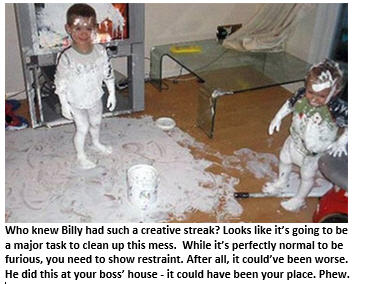
As a parent of two boisterous young girls, I quickly came to two conclusions: First, the interior of the VCR makes an ideal place to hide daddy’s slice of apple pie; and second, being a parent was going to require Herculean levels of patience. Being a good parent means having the maturity to resist saying the first thing that pops into your prefrontal cortex when your eight-year-old microwaves your cell phone. You need to suppress the urge to blurt out, “Jesus Christ! What the hell were you thinking, spraying the cat with the purple paint, you little twerp?” Such an outburst could permanently damage your precious angel’s delicate self-esteem – much like my angel permanently damaged our precious leather couch with a stick figure etching of her daddy.
Shortly after our girls acquired rudimentary speech, I learned a valuable lesson: Never use foul language in front of young children. When my eldest was barely three, I caught her wielding my $500 Titleist driver into the trunk of our cherry tree, “just like George Washington, Daddy!” While she hadn’t yet mastered conjugating a sentence, she had, to my surprise, absolutely no difficulty reciting back to mommy the entirety of my panicked outburst – verbatim: “Mommy, Daddy said, ‘Holy shit. Look what you’ve done to my club!’ What does ‘shit’ mean, Mommy?”
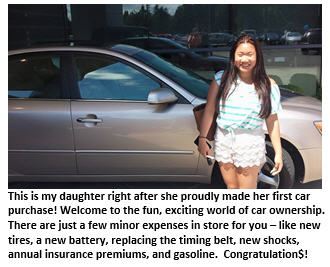
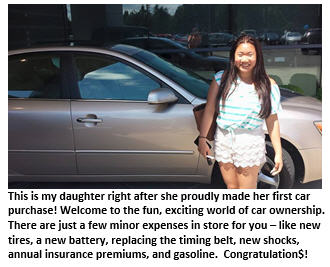
Recently I helped our younger teenage daughter, Emmy, purchase her first car. She had no idea how much used cars cost. I think she was hoping to afford a slightly used Lexus. What she got instead was a lesson in how much cars actually cost. Emmy hates it when I mention her by name in my blog, so I will just call her “Miss Enthusiasm” – “M. E.” for short.
When we started this process, like a lot of young people, Emmy’s, I mean M. E.’s concept of buying a car was rather simplistic: You buy a Japanese luxury car on Craigslist from someone you’ve never heard of named Vinny for a few hundred dollars. Your only ongoing expense is the gasoline fill-ups required four times a year. Period, the end. More esoteric concepts like collision & liability insurance, vehicle registration, tire rotations, oil changes and other routine maintenance were vague abstractions that she had never quite grasped – mainly because she invariably tuned out my relentless attempts to explain the substantial ongoing costs of vehicle ownership. I apologize, M.E., for intruding upon your much more fascinating texting conversations with Haley on more important topics like whazzup.
When the time finally came for her to look for a car, I told M. E. I would contribute up to $3,000 towards the cost. Anything beyond that – including insurance was her responsibility. The only part I am sure she heard was the part of about me paying $3,000 – which is really all she needed to know, because she was pretty sure that figure would be enough to get her that brand new 2015 Lexus LS she saw on TV. I explained to her that cars cost a lot more than she imagined, so she reluctantly lowered her sights towards a used car – specifically the 2013 Lexus LS – ideally with the Bose surround-sound stereo system and the chrome wheel package. I could tell I was in for an exhausting couple of days.
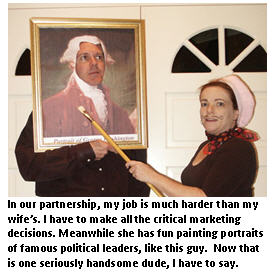
Recently my wife Michele and I started a new chapter in our lives by moving to a lovely, somewhat remote island. We also decided to start working together. We thought, what better way to strengthen our marriage than to spend every waking minute of every single day together – eating, playing, sleeping and now working? What could possibly go wrong?
Okay, I know what you’re about to say: What were you thinking? But before you question our wisdom, I should point out that our skill sets are remarkably complementary. On the one hand, my wife is an extremely talented portrait artist. And on the other hand, I am the husband of an extremely talented portrait artist.
My job will be to market my wife’s portrait business. I am an experienced professional marketer. For example, remember the pet rock – a crazy, fun idea from the 1970s that generated millions in sales simply by packaging an ordinary rock in a box with funny instructions about how to care for it? Brilliant marketing. No, that was not actually my idea. But the idea for selling a 25-pound box of litter for your pet rock was mine. Sadly, it never made it to market. Okay, perhaps this isn’t helping make my point about being a marketing guru.
My wife wanted someone to oversee marketing so she could spend more time painting – and shooting down every marketing idea I came up with. (I still think my idea for her to parade the sidewalks of Seattle in a sandwich board handing out coupons for $10 off a portrait would have worked. But alas, we’ll never know because she squashed that idea, too.)
When it comes to parenting, I don’t always make the best decisions. I’m not always sure what the right thing to do is in a difficult situation.
Like the time our elder daughter begged and pleaded with me to let her drive the car to the mall. It was a sunny day. Traffic was light. And she had behaved extremely well all week long. So against my better judgment, I said okay. Two minutes later, she smashed the car into a stop sign barely 100 yards from our driveway. A part of me can’t help but wonder whether in retrospect I made a mistake giving in to the incessant pleadings of an eight-year-old to drive my minivan.
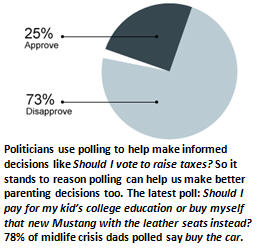
Sometimes my wife questions my ability to make the right call. Heck, she rarely listens to any of my opinions unless at least four complete strangers tell her the exact same thing – which got me to thinking: maybe the way for me to make better parenting decisions is to poll the opinions of total strangers.
In the most recent presidential election, the polls were incredibly accurate forecasters of people’s voting preferences. Nate Silver’s 538 blog accurately predicted the Electoral College winner in all fifty states. Politicians use polls all the time to help them decide how to vote. Should we legalize gay marriage? Poll your constituents. Should we cut defense spending? Do a poll. Should we ban hurricanes during the last week of a presidential campaign? (97% of Republicans resoundingly voted yes.) (more…)


 Remember way back when, before you had kids, how you and your spouse would go on romantic getaways to exotic destinations like Cancun or Paris or maybe Santorini? Ah, such relaxing vacations. But then you screwed up everything by deciding to start a family. Oh sure, having young kids doesn’t mean you can no longer go on vacations. It just means you can’t enjoy them.