Recently, there has been almost nonstop coverage about Artificial Intelligence and how it just might be the most dramatic technological change ever to impact humankind. While there are countless obvious benefits (like saving millions of high school students the need ever to come up with an original thought or put in any effort on their upcoming term paper about the French Revolution), there are increasing concerns about the potential for AI to become “super intelligent” to the point that humans may no longer be able to contain it.
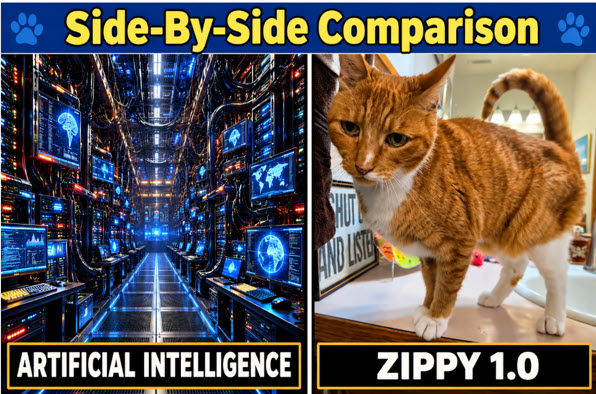
Which brings me to my cat, Zippy, who has almost no intelligence, real or artificial. Last night, around 4:00 a.m., as I was debating how long I could lie there before having to get up for the third time to pee, Zippy jumped in bed to insist on cuddles. As he parked his twelve-pound, orange fur-covered chassis directly on my nasal and oral cavities, it caused me to pause and ask an unsettling question: If I could only have one – the cutting-edge marvel of AI or Zippy – which would I choose?
Before you jump to the conclusion that the obvious choice must be AI because it can execute trillions of calculations in a split second, while Zippy has no idea what the word “Zippy” means, I think the discussion warrants a deeper dive.
I hired a team of elite computer scientists, tech analysts, and a veterinarian friend of mine to conduct a rigorous comparative evaluation. Here are the empirical findings from their feature-by-feature benchmark analysis.
Ability to Make Multiple Computations Quickly
AI: Armed with massive server farms and advanced neural processing networks, AI apps like ChatGPT, Claude, and Grok can analyze vast datasets, translate ancient Greek poetry into conversational Mandarin, and solve complex differential equations in 0.0004 seconds.
Zippy 1.0: Zippy’s central processing unit operates at a clock speed roughly equivalent to a baked potato. When confronted with basic variables – such as calculating the trajectory required to leap from the coffee table to the couch – Zippy routinely misjudges the friction coefficient, hits the cushion at a bad angle, and slides embarrassingly onto the hardwood floor.
Edge:AI.
Ability to Follow Instructions
AI: When given a precisely defined prompt, most AI programs execute the task with meticulous compliance. Ask it to write a 500-word essay on soil erosion in the voice of a pirate, and it delivers in seconds. Seven seconds longer if the prompt asks it to be written in Shakespearean iambic pentameter.
Zippy 1.0: Zippy possesses a unique operating system that filters all incoming auditory data directly into his recycle bin. Screaming “NO! STOP SCRATCHING THE QUILT!” yields zero latency reduction in his scratching protocol. However, he demonstrates near-instantaneous response times if the instruction involves the acoustic pitch of a cat food pop-can tab being opened three rooms away.
Edge:AI.
Thermal Output and Heat Generation
AI: High-performance AI datacenters require millions of gallons of liquid coolant and massive industrial HVAC units just to keep their silicon microprocessors from melting through the earth’s crust.
Zippy 1.0: Zippy generates localized, self-sustaining thermal energy using an internal biological combustion motor powered entirely by Friskies Party Mix treats. He automatically deploys this heat directly onto your chest, lap, or fresh laundry stack, completely free of charge and without requiring an external radiator.
Edge:Zippy 1.0.
Shedding and Physical Debris Production
AI: As a cloud-based software construct, AI programs leave zero physical residue, save for the occasional digital footprint on server hard drives.
Zippy 1.0: Zippy produces an infinite volume of fine orange bio-fibers. He sheds on the furniture; he sheds on your dark trousers; He even sheds into sealed containers of leftovers that haven’t even been opened yet. Scientists on my testing panel remain baffled as to how a cat weighing twelve pounds can shed fifteen pounds of fur per week without completely disappearing.
Edge:AI.
Likelihood of Hacking Into Your Bank Account and Wiping Out Your Retirement Funds
AI: Given its integration into digital networks, an autonomous super-intelligent AI could theoretically breach high-level encryption, liquidate your 401(k), purchase 80,000 shares of volatile penny stocks, and transfer your life savings to an offshore account before you finish your morning bowl of Lucky Charms cereal.
Zippy 1.0: Zippy lacks both network interface capabilities and basic economic literacy. While he may occasionally walk across your keyboard and send an unintelligible email consisting of ffffffffffffffjkkkkkkk to your boss, his financial threat level is strictly limited to knocking your wallet into the sink.
Edge:Zippy 1.0.
Energy Efficiency and Resource Consumption
AI: Running advanced large language models requires gigawatts of electricity, consuming enough power daily to light up a medium-sized European nation.
Zippy 1.0: Zippy operates on approximately 180 calories of Fancy Feast Salmon Delight per day. In exchange for this minimal power input, he provides up to 22 hours of continuous, low-power standby mode (napping) and periodic brief bursts of hyper-kinetic activity – usually at 3:15 a.m. as he leaps, claws-first, onto your face.
Edge:Zippy 1.0.
Risk of Becoming Your Tyrannical Overlord
AI: Futurists warn that once AI achieves artificial general intelligence, it may view humanity as an inefficient biological bottleneck, quietly seize control of power grids, traffic signals, and automated weapons systems, and subjugate the human race under a cold, calculated digital dictatorship.
Zippy 1.0: Zippy already firmly believes he is your supreme ruler and that you exist solely to serve as his primary food-dispensing system and door-opening liaison. However, his dictatorial authority is severely hampered by the fact that he gets frightened by the sound of a bird chirping and can be easily stuck in a closet.
Edge:Zippy 1.0.
Potential for Destroying All of Humankind
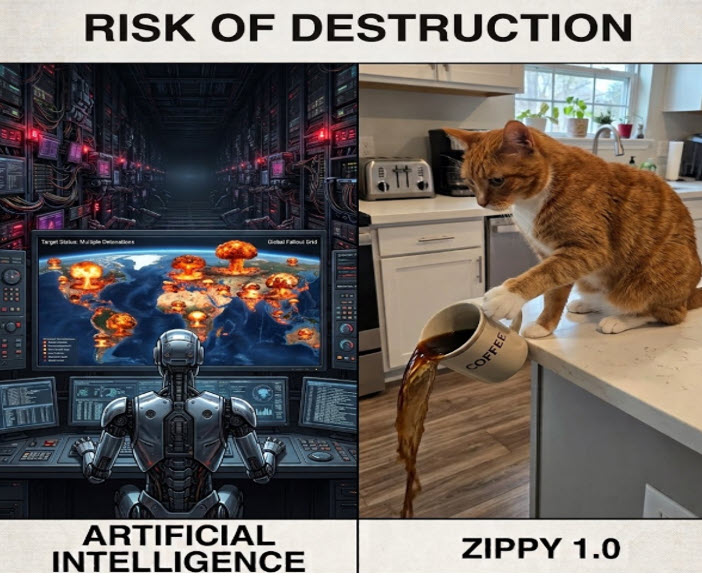
AI: If an unaligned AI system determines that the most efficient way to optimize global resource distribution is to eliminate carbon-based lifeforms, it could potentially manipulate global infrastructure, release bio-agents, or launch automated defense systems to attempt an existential extinction event.
Zippy 1.0: The absolute maximum destruction Zippy can inflict is strictly localized. At worst, he can shred the woven fabric on the armrest of my custom leather sofa, tip over my glass of chocolate milk onto my laptop keyboard, or trip me on the stairs in the dark.
Edge:Zippy 1.0.
Final Verdict
When evaluating the aggregated metrics, AI undeniably wins on raw processing power, task execution, and lack of shedding. However, when factoring in existential risk assessments, the final decision becomes clear. While AI chatbots like ChatGPT offer unmatched productivity, it carries an inherent, non-zero probability of initiating a rogue protocol that ends human civilization as we know it.
Zippy 1.0, on the other hand, presents less than a 1% risk of starting a global thermonuclear conflict – primarily because he completely lacks opposable thumbs and spends 90% of his awake time searching for a cardboard box to curl up in.
Therefore, ultimately scientists give the nod to Zippy. And personally, I’ll take a purring, orange feline who occasionally pees on my carpet over a hyper-intelligent machine overlord any day of the week.
That’s the view from the bleachers. Perhaps I’m off base.
PS: If you enjoyed this week’s post, let me know by posting a comment, giving it a Likeor sharing this post on Facebook.
Over the past two years, I’ve become mildly obsessed with the sport of pickleball, often beginning conversations with total strangers by asking, “So, what’s your DUPR rating?” And that’s in the checkout aisle at the IGA. Wanting to share this passion, I naturally turned to the only consistent companions I have who don’t complain about my backhand: my cats, Zippy, Buddy, and Monster.
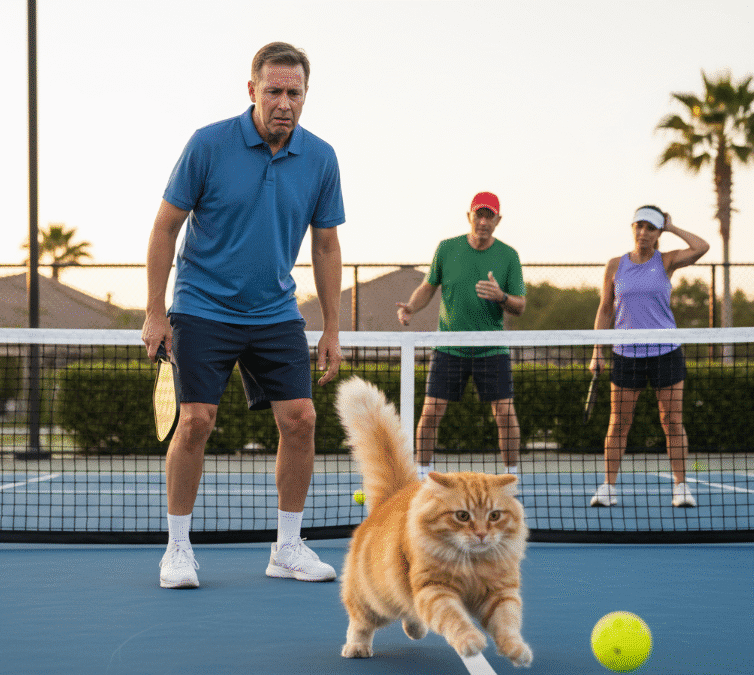
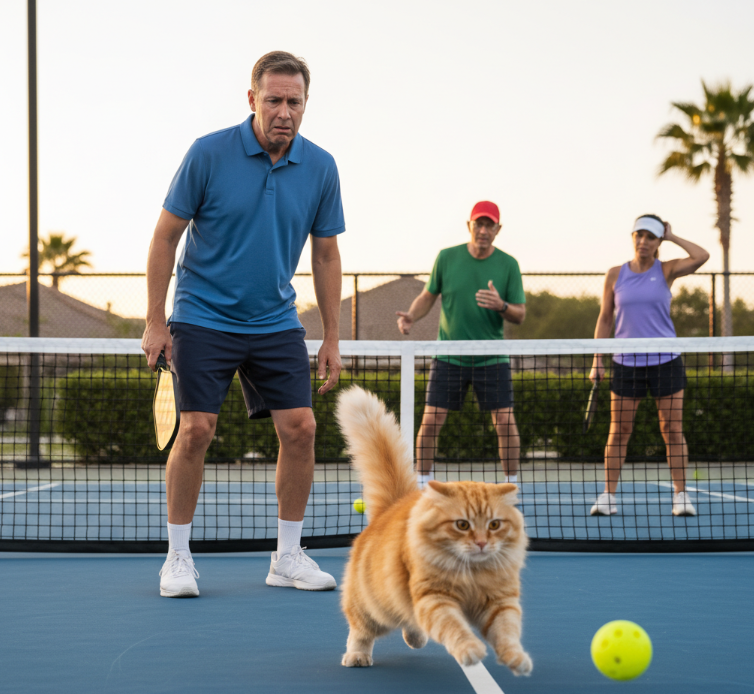
For the better part of three months, I tried to teach them the fundamentals: Dinks, volleys, poaching, serving – none of it seemed to stick. But the hardest concept by far was getting them to stay out of the kitchen. Not the actual kitchen (they’re very good at staying in there, especially during tuna time), but the pickleball kitchen – you know, the area near the net where you’re not supposed to volley. I explained the rule over and over, but they just stared at me, knocked over my water bottle, and went to sleep next to the ball machine.
And don’t get me started about scorekeeping. I discovered that cats are terrible at math. I’d say, “The score is 4-2-1,” and Zippy would stare blankly at me, flick his tail, and start chomping on the ball. Buddy once attempted to keep track by scratching tallies into the court, which I appreciated until I realized it was actually my leg.
Then there’s the issue of team dynamics. Pickleball is a social sport, requiring cooperation and communication. Cats, on the other hand, are more of the “I’ll sit on your paddle while you cry” kind of teammate. During doubles matches, they frequently refused to cover their side of the court, preferring instead to lie motionless in a sunbeam and lick their toes during key rallies.
Their agility, while impressive in leaping onto kitchen counters or knocking over my coffee so it spills on my laptop keyboard, doesn’t translate effectively to pickleball footwork. You’d think reflexes honed by generations of predatory instinct would come in handy – but no. When a ball comes their way, they either swat it lazily into the neighbor’s yard or stare at it like it’s beneath them. Which, to be fair, it probably is.
I even tried incentivizing them. Treats, laser pointers, catnip-infused wristbands – nothing worked. They showed brief enthusiasm for the ball itself, but mostly to chase it under the couch and then refuse to retrieve it, resulting in me spending 40% of my training sessions with a broom handle and a strained lower back.
Let’s not even get into their attitude during line calls. Every disputed point resulted in Monster walking off the court in protest, usually straight to the litter box, where he would make his opinion very clear.
In conclusion, while my initial goal was to train a competitive feline pickleball doubles team, I have been forced to reconsider. It’s not that they can’t play – technically – but they lack focus, sportsmanship, and any concept of teamwork. Not to mention opposable thumbs.
I have to say, with great disappointment, that you should probably not waste any significant amount of time trying to teach your cat the finer points of pickleball. You’ll have a much higher likelihood of success with a Labradoodle.
That’s the view from the bleachers. Perhaps I’m off base.
PS: If you enjoyed this week’s post, let me know by posting a comment, giving it a Likeor sharing this post on Facebook.
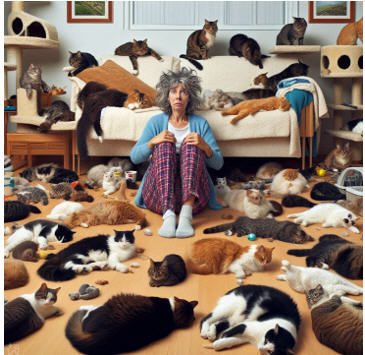
How many cats is the right number for you? Some people have difficulty knowing when to stop. Like this lady. When she got to the point that she couldn’t take 3 steps without tripping over a cat, that should have been a tipoff she had a few too many furry house guests.
As someone who’s lived with cats throughout my entire marriage (my wife required me to insert “and our cats” into my wedding vows), I often have people come up to me asking questions like, “Dude, why are you staring at me?” But sometimes they ask, “Tim, how many cats is the right number to own?” My response: “How many potato chips are you supposed to eat? Just one? Impossible! Same with cats.” [And to my neighbor, Bert, who sometimes takes my words too literally, I did not mean to imply that like potato chips, you should actually eat lots of cats. Just pet them, for God’s sake.]
As a lifelong cat enthusiast and part-time lint roller tester, I consider myself a leading authority on the subject of the ideal cats-to-humans ratios. We’ve been cat owners for four decades. Of course, the matter of who in this partnership are the true owners – us or our cats – is a topic of heated ongoing debate with our feline companions.
All our cats joined our family the same way. My wife would go to the local animal shelter without telling me and come home with three to six orphan kittens – sometimes with their mom cat – and would say, “Look, aren’t they adorable?” That’s where her official fostering responsibilities ended. The job of feeding them, scooping their litter, and cleaning up the mess they always created fell to me. And in the process, I’d inevitably start to become attached.
Then, when it came time to return them to the animal shelter, I would negotiate with my wife in an attempt to keep some of them. My opening bid usually was, “Honey, can we keep all five of them?” To which my wife’s response was something along the lines of, “You’re insane. I’ll agree to keep one kitten.” There’s even a term for when foster families fail to return kittens to the shelter. It’s called a “Foster Fail.” I am a serial foster failer. You may be asking, “So, Tim, how many cats do you currently own?” Um, our current cat count is classified, mostly because the head of our HOA reads my columns.
If you’re thinking about adopting a cat, ask yourself, How Many Cats Should I Have? Here’s a summary explaining the ideal number of cats to invite into your home and subsequently take over your life:
1 Cat: Talk about a lame effort. Why would anyone adopt just one kitty? Tell me, who’s going to keep him company when you’re at work all day? You’ll leave him no choice but to rip up your brand new leather sofa in protest to being sentenced to solitary confinement nine hours a day.
2 Cats: That’s the bare minimum. At least now they each have a playmate, and they can re-direct some of their razor-sharp clawed sneak attacks planned for your bare calf towards their furry housemate instead.
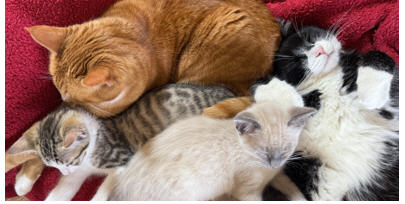
This is a photo of our four cats, Zippy, Buddy, Dust Bunny, and Eddie. Our fifth Cat, Monster, was not available for this photo due to a prior commitment he had with a fascinating twist tie he’d just discovered in the front hall closet.
3 – 4 Cats: You’re in the sweet spot. With this number you can be assured there will always be at least one furry friend curled on your lap, another watching you from the kitchen counter where he is clearly forbidden, and one plotting to knock over your glass of red wine onto your laptop keyboard.
5 – 9 Cats: Yikes. You might want to think about getting off the adoption train at the next stop. At this number, you’ll need at least three scratching posts and you’re probably contemplating the need to cover your leather furniture in plastic wrap or burlap. By now you’ve probably purchased a Roomba which you run daily, in a vain attempt to keep the stray fur at ankle depth. You no longer invite friends over, out of sheer embarrassment.
10 – 19 Cats: Whoa, Nelly. I’m starting to seriously worry about you. At this level, you probably have noticed most of your former friends are now shunning you. Nice job on the wall-mounted cat walkway that completely encircles the entire main floor. You might want to consider joining a support group… or better yet, get a life.
20+ Cats: Okay, now we’re veering into “future Netflix documentary” territory. At this point, the cats have totally taken over just about all the horizontal surfaces of your house, leaving you only the moldy futon in the basement as your new sleeping quarters. When neighbors whisper about “those crazy cat people,” they’re talking about YOU.
So, what’s the ideal number? My professional opinion: somewhere between three and “my neighbor just called Animal Control.” More than 15, and I’d say you’re probably a prime candidate for a future episode of Dr. Phil about cat hoarders. If you’re spending more on cat food and litter than on your mortgage, it may be time to seek financial and psychological counseling.
Studies I just made up show that cat ownership reduces anxiety, increases happiness, and boosts your immunity to loneliness and cat-allergic friends. Owning multiple cats has proven psychological advantages, like instant therapy: Nothing calms the soul like several sets of eyes staring at you ravenously while you eat tuna.
Cats provide consistent companionship. You’ll never be alone again – whether you want to or not. Not even in the bathroom. Definitely not during your Zoom meeting with your boss. And at bedtime, enjoy the pure joy of snuggling with your favorite furry friend, as he peacefully falls asleep on your face just before you wake up in terror and suddenly realize he’s about to suffocate you. So adorable.
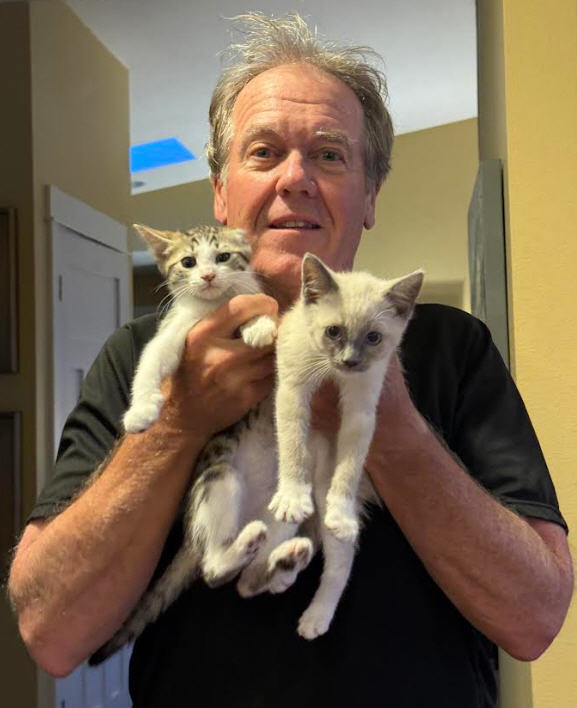
Here I am with the two latest additions to our fur family: Eddie and Dust Bunny. Our cats give us 60% of our daily laughs and giggles. The other 40% mostly comes from watching cat videos on YouTube.
Owning multiple cats is not a hobby – it’s a lifestyle. Like knitting, but the yarn fights back. Sure, you’ll spend a good chunk of your disposable income on vet visits, cat food, cat toys, and an entire new living room set to replace the previous one that your cat named Monster destroyed. But in return, you’ll receive unconditional indifference, the occasional head bop, and a house full of fluffy, judgmental roommates who you try to convince yourself actually love you back, but, to be honest, you’ll never know for sure.
So my advice is this: No matter how many cats you currently have, there’s always room for one or two more. Over time, they may even help you totally forget about the fact that your spouse left you because they could not stand living in a cat house and constantly tripping over 15 empty boxes from Amazon (cats’ favorite place to chillax).
That’s the view from the bleachers. Perhaps I’m off base.
PS: If you enjoyed this week’s post, let me know by posting a comment, giving it a Likeor sharing this post on Facebook.
Cats are the most popular pet in most western countries. That’s because they’re furry, extremely cute, make a soothing purring sound, and help their owners procrastinate whenever they jump on our laps. Good kitty. Daddy didn’t want to defrost the fridge anyway. I’d rather pat you instead.
Cats living with humans dates back over 10,000 years. But in all that time, there is not a single documented case of a cat ever thanking its human cohabitant. In ancient Egypt, people worshipped cats as gods. To this day, that’s still how most cats see themselves.
Throughout history, cats have served many valuable functions for their owners. In many early civilizations, as cats became domesticated, they were kept as a means of chasing away snakes and killing mice and other rodents in order to protect the grains in storage.
It is speculated that cats were once used to herd sheep and cattle. However, historians say this practice was believed only to be associated with one group of people in medieval Wales. Apparently this terribly in-bred population suffered from a genetic defect in which everybody was severely near-sighted, and thus they mistook cats for dogs. Before long, this society appears to have died off, most likely from widespread starvation – because they kept losing their food supply of sheep and cattle. It turns out even back in the 700s, cats were terrible at herding. Many generations later, the entire tribe was posthumously given the Darwin Award.
In more recent times, cats have been adopted into families as household pets – mostly by lazy couples who preferred cats over dogs because they’ve concluded that getting up at 5am on a December morning to walk the dog and scoop up its poop on a frozen sidewalk was way too much work.
Throughout my marriage, we’ve owned cats as pets, typically two or three at a time. Don’t worry, I never became one of those “crazy cat people” with a dozen cats – because my wife would never agree to this. We love our cats dearly, but over the years, we’ve had to replace several living room chairs and many blown glass vases, thanks to our cats’ hardwired obsession with scratching furniture and knocking onto the floor anything on a counter that looked expensive.
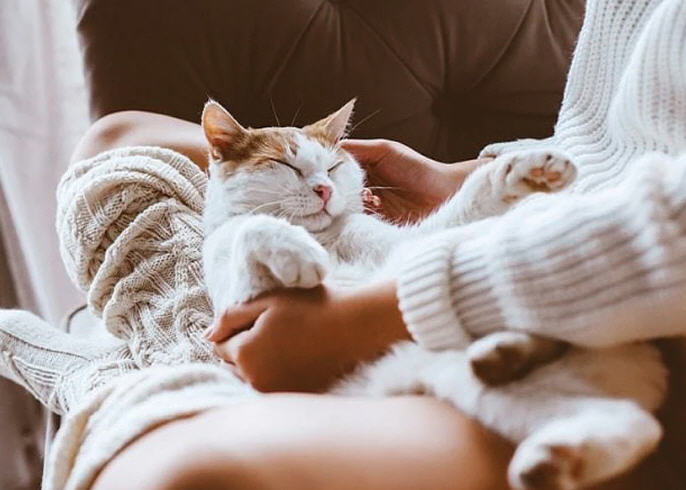
In recent years, I have found yet another extremely useful function for our three cats, Buddy, Zippy, and Monster: I frequently use them to get out of having to help my wife with chores. That’s because we have a tacit agreement: Whenever one of us is lying on the couch, and there’s a cat on our lap, we mustn’t disturb our furry friend from their peaceful slumber.
As a result, whenever a cat is looking adorably cute, lounging comfortably on my lap, I get an immediate hall pass to avoid helping my wife with any chores until my fuzzy feline decides it’s time to move on to something more fascinating – like a nearby twist tie or a piece of lint. And our giant moose of a cat Buddy has been known to park himself on my lap for hours at a time, all but guaranteeing I won’t have to lift a finger for the rest of the afternoon.
This is our cat named Buddy. He’s huge. And he loves nothing more than to park himself on my lap and stay – usually within 30 seconds of when I was planning to get up to make myself a snack.
This system has been working wonderfully for me. For example, let’s say my wife could use a little help in the kitchen cooking dinner. As she’s getting close to the point where I anticipate she’ll likely be asking for my assistance, I make sure to grab say, Monster, park him on my lap and pat him until he settles in for a nice long nap. “Hey, honey, I would totally help peel the potatoes, but I’m stuck. I have a cat on my lap.” Chore averted.
But be careful not to abuse this strategy. A few years ago, during the peak of the pandemic, I was working from home. My boss asked me for my quarterly sales forecast. I tried to explain that I was not ready to present it at our Zoom meeting because there had been a cat on my lap for the previous two hours.
I figured my boss would understand. Turns out she had no sympathy for my predicament. I made the mistake of working for someone who was a dog person. (It’s my fault for not asking her about this during my job interview.) She had this crazy notion that focusing on my job during work hours took priority over patting kitties. Such a heartless person. I would have submitted a formal harassment claim to the HR department but I couldn’t – because I still had a cat on my lap – and our small company did not have an HR department.
I have been able to avoid raking the leaves, doing laundry, and power-washing the driveway for weeks at a time, thanks to this “Cat On My Lap” (COML) addendum to our marriage vows. But lately, our cat Zippy has been gravitating more to my wife’s lap than mine, thus ruining the balance of cat lap time that had been disproportionately favoring me. My wife is deliberately attempting to turn the tables by claiming “I’d be happy to help you with the gardening, but as you can clearly see, Zippy is parked on my lap.”
As far back as 2,500 years ago, in ancient Egypt, cats were revered. Here is a piece of funerary fabric depicting a cat trying to decide which priceless urn to knock over. It ultimately chose the one on the right.
Our COML agreement worked perfectly when Zippy preferred my lap to my wife’s. But lately he’s turned into a traitor. Even Buddy – who ALWAYS prefers me – has taken to preferring my wife over me for cuddle time. What’s going on??!! My wife has nefariously used this technique to get me to cook dinner three nights in a row – and clean the BBQ grill. So unfair. I think she’s bribing the cats, but I have yet to catch her in the act.
This has to stop. I’m going to start spraying all my wife’s clothing with a dog fur cologne. (I wonder if Amazon has this in stock.) Hopefully, they’ll start to view her with suspicion or even terror and return to choosing my lap over hers, thus restoring order to the cat universe.
I know, it sounds extreme. But when it comes to my relaxation and my desire to avoid helping out around the house, sometimes a husband has to take drastic measures.
That’s the view from the bleachers. Perhaps I’m off base.
PS: If you enjoyed this week’s post, let me know by posting a comment, giving it a Likeor sharing this post on Facebook.
It’s no secret that my wife and I are crazy about cats. We’ve fostered dozens of kittens and adult cats over the years. We currently belong to three (formerly) male cats who were all once fosters: Zippy, Buddy, and our newest family member, Monster. Some readers may even recall that Zippy once authored a tell-all book trashing me. But we settled out of court for an undisclosed amount.
We pet owners sure do love our furry companions. Many people, like my good friend and fellow humor writer Dorothy Rosby, even talk to them on a regular basis.
And sure, I talk to my cats too. Who doesn’t talk to their cat? (Unless they are one of those freakishly ugly hairless sphynx breeds – I just don’t trust them.)
When I talk to my cats, it’s always about important things, like whether my Seattle Seahawks should trade their quarterback Russell Wilson for a pair of first round draft picks or reminding them to make the bed after I get up in the morning or asking them if there’s anything good on TV. I can’t say with 100% certainty that they always understand what I’m saying, but they never ask clarifying questions, so I presume they’re tracking with me.
Cats are a lot smarter than most people think. One clever cat lover even wrote a book called Why Cats Paint. It was so successful that I plan to rip off his idea and pump out a series of similar books, including Why Cats Cook, Why Cats Bowl, and Why Cats Don’t Particularly Care About Particle Physics.
Some people wonder whether cats actually love us back. I can say with confidence that Zippy and Buddy love me. The verdict’s still out on Monster, ever since I recently put him in the laundry room for two days for peeing on the bed. He holds onto grudges.
I truly adore our cats, even though they almost never offer to help with the chores. That said, any time I put new sheets on the bed, Zippy is always eager to help – which he does by jumping up on the bed (right before I put down the fitted sheet) and lying there for hours under all the new warm sheets and blankets. Even when one of them misbehaves, I can’t stay mad at them. I even forgave Buddy the time he leapt up on my laptop keyboard and somehow instantly managed to delete a humor article I’d been laboring on for three hours but had failed to save. But did he ever apologize? Sadly, no.
I like to give our cats several nicknames. For example, I have periodically called Monster Pumpkin, Cuddles, Squawker, BumpelRumpinface, and most recently, The Evil One Who Must Be Destroyed. But they always seem to respond to my call, regardless what name I call them (so long as I come bearing treats).
I also like to tell jokes to my cats. But when it comes to humor, they are a tough audience. Whenever I read them portions of my latest column, they rarely chuckle or even smirk. Typically they just stare at me until they realize I don’t have any treats, then walk away – so, pretty much the same response I get from my wife.
Millions of cat owners routinely proclaim their affection for their furry friends by snuggling with them and telling them how much they love them. Like I said, I do that too. But I also sing to my cats – with original lyrics I make up. That said, I’ve never been able to come up with a song lyric that rhymes with “Monster.” I’m seriously considering changing his name to Ned or Brad, both of which are much easier to rhyme.
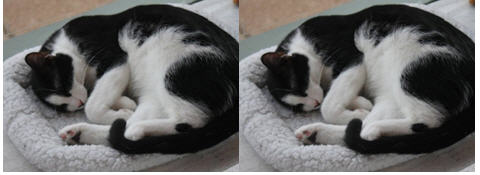
At left: Our tuxedo cat Buddy fitfully trying to sleep. Notice how stressed out he appears. My guess is he’s worried about when he’s going to be fed next. At right: Buddy after I just sang him a song I wrote about bunnies. See how totally Zen he is. Buddy finds my music very soothing.
My songs cover a wide variety of timely topics from “I can’t see my computer monitor with you sitting there” to “Would you like to go bungee jumping with me tomorrow” to “how’d you get so fat – did you eat your brother?” – all in perfect rhyme but far from perfect pitch. I’m pretty sure my wife enjoys when I break out in song for our cats because whenever I start up, she immediately goes to another room (no doubt for better acoustics).
Hey, Hey, Zippy, now you have jumped up on my pants
I wish you wouldn’t leave
All of your fur on my pant sleeve
Hey, Zippy, don’t make me ship you to France
I’m thinking of making an album called Pet Sounds (I sure hope nobody else has used that name yet). Oh sure, you may think I’m a bit quirky since I like to sing to my cats. I mostly croon Broadway show tunes, pop songs, and the occasional Gregorian chant. It’s not like I would ever sing them opera arias because that would be ridiculous.
Trust me, I’m not obsessed with our cats. I would never dress them up in silly costumes. And I would never install one of those giant cat walls that go around half the living room for them to climb up on – unless my wife changes her mind about that.
That’s the view from the bleachers. Perhaps I’m off base.
PS: If you enjoyed this week’s post, let me know by posting a comment, giving it a Likeor sharing this post on Facebook.