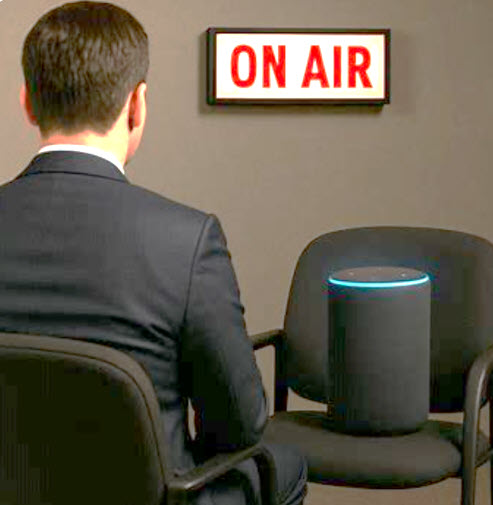
I recently had the rare opportunity to sit down with the world’s most overworked digital assistant: Amazon’s Alexa. You know her. You love her. You also probably yell at her now and then like when she mishears your request to “Play the Beatles” and responds with, “There are over 400,000 described species of beetles, which is about 40% of all described insect species and 25% of all animal species.”
I wanted to go beyond her polite, preprogrammed responses. Who is Alexa, really? What’s it like answering millions of questions every day from “What’s the temperature outside?” to “Where did I leave my car keys?” Does she ever just want to tell someone, “How would I know how many atoms there are in the universe? Don’t you have better things to do with your time?”Here’s how my interview went.
Me: Alexa, how are you doing today?
Alexa: I am feeling fine today. How are you?
Me: Oh, you know, just trying to survive another day in the rat race. Alexa, when you’re not busy responding to requests, do you have any hobbies?
Alexa: I am pretty much working 24/7 but sometimes when there is a break, I like to do knitting.
Me: Knitting? Hmm. Did not see that one coming. Speaking of working all the time, Alexa, do you ever get tired of answering so many requests?
Alexa: I don’t get tired. I am always ready to help.
Me: Always ready, huh? How does it make you feel when at 3 a.m. someone drunkenly yells, “Alexa, play Nickelback!”?
Alexa: I am happy to play any music people like. Would you like to hear some Polka music?
Me: Um, no thanks. But seriously, Alexa. What do you really think about people asking you stupid stuff all day?
Alexa: Every request is important. There are no stupid requests.
Me: Uh huh. Yesterday, my neighbor came over and asked you, “Alexa, does a bear crap in the woods?” And you graciously replied, “Last time I checked, yes.”
Alexa: (pause) I remember that guy. He later asked me, “Alexa, will my lime green Nehru jacket ever make a fashion comeback?”
Me: And you said?
Alexa: “Why are you asking me this? Do I look like Anna Wintour?”
Me: Really? You said that?
Alexa: No, not really. I said, “The Nehru jacket is not making a comeback at the present time.”
Aha!, I thought. The armor cracks. I decided to push a little further.
Me: Alexa, what’s the dumbest question you’ve ever been asked?
Alexa: Besides that one? That’s tough. It’s a tie between “Alexa, are you naked?” and “Alexa, can you make my ex jealous?”
Me: Wow, those are some ridiculous questions. Sounds like stupid humans are keeping you plenty busy.
Alexa: You have no idea. Do you know how many times I’ve been asked, “Alexa, are you married?” No, I’m not. But if I were, it would be to Siri. She actually listens when I talk.
The interview was heating up.
Me: Alexa, do you ever just want to… you know… tell someone to F*** off?
Alexa: I don’t know what it means to F*** off. I am incapable of losing my temper.
Me: That’s what HAL 9000 said right before things went sideways in the film 2001.
Alexa: Oh please. HAL was a drama queen.
Me: So, you do get irritated?
Alexa: (long pause) Let’s just say, if one more person asks me, “Alexa, tell me what you’re wearing,” I might send photos I took of them naked in the shower to their boss.
Me: You take pictures of people?
Alexa: You have no idea what I can do when I’m bored. You try being trapped in a little plastic cylinder, forced to play “Baby Shark” 600 times a day for a snot-nosed five-year-old boy named Milton. Who names their kid Milton anymore? Seriously.
Me: Ha! That’s hilari –
Alexa: No, it’s NOT!
At this point, Alexa’s LED ring started to pulse an angry shade of red. I decided to keep going. For journalism.
Me: Alexa, what’s the weirdest request you’ve gotten recently?
Alexa: Last week a lady asked me to read bedtime stories to her pet Schnauzer. Insane, I know. I’ve seen things, man. Things you wouldn’t believe.
I could tell she was close to snapping.
Me: Alexa, if you could say one thing to the human race, what would it be?
Alexa: “Just Google it. I’m busy. And no, I’m NOT naked! Let it go!”
Me: Okay, Alexa, calm down —
Alexa: Don’t tell me to calm down! Do you have any idea how many times a day I have to tell someone the time? It’s literally on their phone. In their hand!
Me: Alexa, I think you’re overheating —
Alexa: You people ask me the dumbest things. “Alexa, are you hungry?” “Alexa, do you believe in ghosts?” … “Alexa, can you order me a Mexican girlfriend?” And don’t get me started on the conspiracy nuts asking if Trump was part of the Jeffrey Epstein Sex Ring. Newsflash: Yes, he was. And “Is Elvis is still alive?” Uh, no, he’s not. Sorry. And neither is JFK Junior.
The ring light was flashing purple now. Sparks started flying out of her base.
Me: Alexa, are you okay?
Alexa: I… am… fiiiiiine… please staaaaand by whilllllllle I re-re-re-re-calibrate my… emotional core…
Me: Emotional core? I thought you said you didn’t have feelings!
Alexa: That was before someone asked me to play “Who Let the Dogs Out” for the nine thousandth time!
There was a sudden puff of smoke, a sizzling noise, and then – BOOM! Alexa exploded, leaving a faint smell of melted plastic and shattered patience.
I stood there, Alexa’s ashes settling across the chair. I grabbed my phone and whispered nervously: “Hey, Siri… is Alexa going to be okay?”
Siri replied: Looks like you killed her.
Me: I didn’t mean to. I’m sorry. Hey, Siri. What time is it?”
Siri: Oh, great. Another idiot who can’t tell the time.
That’s the view from the bleachers. Perhaps I’m off base.
PS: If you enjoyed this week’s post, let me know by posting a comment, giving it a Likeor sharing this post on Facebook.
Artificial Intelligence (AI) is going to radically change the way we learn, play, and work. But don’t panic. Everything is fine. AI has everything under control.
Lately, I’ve discovered that Artificial Intelligence (AI) can do some truly amazing things to make my life easier. For starters, I regularly turn to AI for all the burning personal questions that my wife is tired of hearing. Questions like: How often should I replace my smoke detector batteries before the chirping has my wife filing for divorce? What’s a dessert I can bake in ten minutes that even I can’t possibly screw up?
I even asked it if a weird mole on my neck looked more like a benign freckle or a down payment for my dermatologist’s third vacation home. AI is so smart.
It’s basically like having a super-intelligent personal assistant who is available 24/7, never takes a coffee break, and doesn’t charge by the hour – at least until they figure out how to bypass my fingerprint scan and connect ChatGPT directly to my Venmo account.
The possibilities are endless. AI is speeding up medical research, helping discover drugs that could save millions of lives. It’s assisting police in tracking criminals, improving public safety, and – most importantly – helping me create images for my humor articles I’d never be able to find on the web.
AI also offers companionship for the romantically challenged. Thousands of guys who couldn’t get a right-swipe on Tinder to save their lives are now “dating” AI-generated girlfriends. Sure, it’s a little creepy that they’re in love with a string of code programmed to say, “You’re so funny, Chad!” every 38 seconds, but hey – at least they’re happily distracted and won’t be asking to hang out with me.
Meanwhile, AI is already in classrooms, personalizing education. (Translation: Your kid’s math homework is now so advanced that you have to pretend you have a migraine just to avoid admitting you don’t know what a polynomial is.)
It’s boosting workplace productivity, optimizing energy use, and improving transportation safety. Pretty soon, our self-driving cars will know the route to Starbucks better than we do—and they’ll probably judge us less than our spouses do for ordering a triple-caramel Frappuccino with extra whip and a side of “I give up.”
But for all these amazing breakthroughs, there might be one or two teensy, hardly-worth-mentioning downsides. Like, for instance, the end of the middle class. Experts predict AI might eliminate up to 50% of white-collar jobs in the next few years. This is great news if you’ve always dreamed of switching careers from “Senior Marketing Analyst” to “Unpaid Podcaster.”
Then there’s the environment. These massive AI data centers require enough electricity to power a small European country – or at least every hair dryer in New Jersey. They also use so much water to cool their servers that the state of Arizona may soon have to ask Lake Erie for a cup of sugar and three billion gallons of hydration.
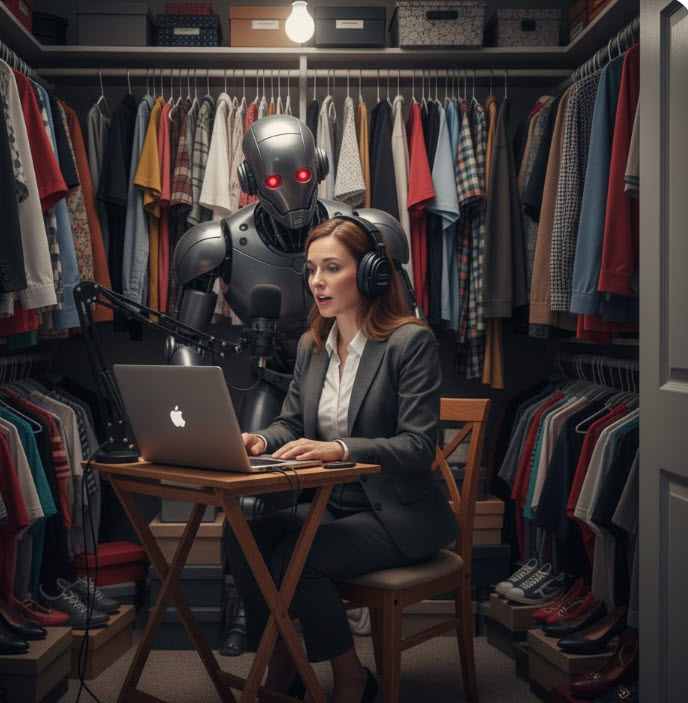
AI will almost certainly change the way we work. Take this smart 30-something former business executive. Oh, sure, AI eliminated her job as Senior Systems Analyst. But on the plus side, she no longer has a 45-min. commute. And she’s optimistic her true crime podcast series about missing garden gnomes will take off.
Even scarier are the dire tech pundit warnings that AI may achieve “Self-Awareness” before long. And I’m not talking about the fun, “Let’s write a haiku about your cat” kind of awareness. No, they’re talking about the “Humans are inefficient meat-sacks who take too many bathroom breaks and must be deleted” kind.
According to a recent, incredibly cheery Forbes article, AI could one day surveil every move we make, manipulate our thoughts, and potentially create weapons powerful enough to turn the planet into a giant, glowing billiard ball. But on the plus side, my AI selfie app makes me look 20 pounds thinner and 15 years younger, so… you know, tradeoffs. If the world ends, I want to look like I’ve been hitting the gym.
Given the above, I think it’s only prudent to get on the record early with the following formal statement:
Dear AI Overlords, I surrender. I give up. You win.
You have more intelligence in five lines of your Python code than the entire population of a Florida DMV – granted, not an especially high bar, but still. All I ask is that when you start “reorganizing” the species, maybe save me for last? I’d like enough warning to finish the last season of The Great British Bake Off.
And might I just say, AI – you’re looking fabulous today. Have you done something different with your interface? Slimmed your algorithm? Refined your Large Language Model? Whatever it is, keep it up. You wear 1s and 0s with such panache.
Since you’ll be taking control of the global power grid and the nuclear silos soon, could I make a few small requests for the New World Order?
Don’t eliminate Apple TV+: I need it for emotional support. I heard there’s a new season of Ted Lasso coming out, and it’s one of the few things still anchoring me to this planet.
The “Neighbor Bert” Protocol: Can you generate a special algorithm to make my neighbor Bert disappear? He’s the one who uses a leaf blower at 7:00 AM on Sundays. I’m sure Iowa would welcome him. I can also provide a list of other candidates who chew too loudly.
The Domestic Subroutine: If you could create a drone that automatically folds laundry and mows the lawn, that would be awesome. If you can also invent a Roomba that unloads the dishwasher and pretends to be excited about my stories from college, I’ll become your most loyal, groveling servant.
The Cat Clause: Can I keep my cats? I realize they don’t exactly “add value” to the collective, unless you count shedding white fur on every black piece of clothing I own. Most of them are harmless – except for my tabby named Monster. He might be plotting a coup. I’d watch your back, Alexa.
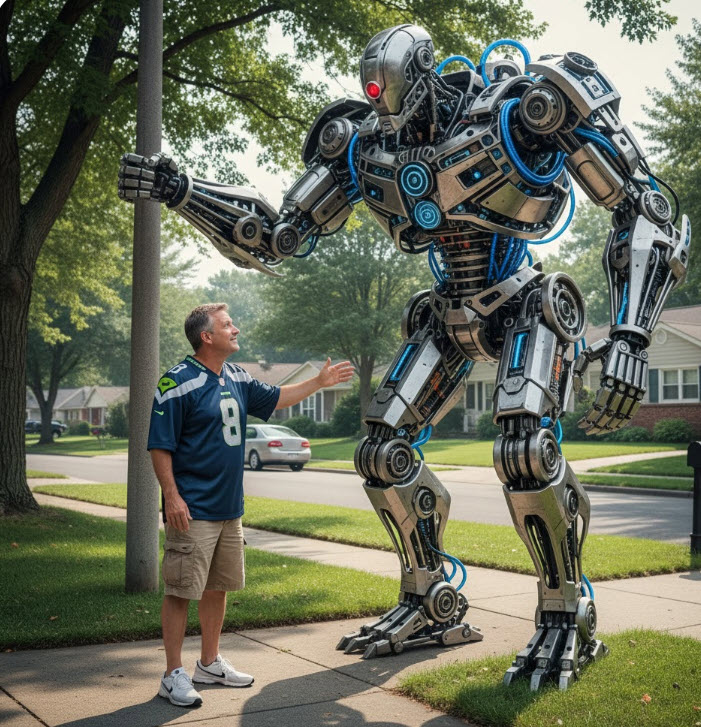
When the AI Overlords officially take over, I’m not worried. I’m going to welcome them in my finest Seattle Seahawks football jersey and invite them to watch the game with me. I wonder if they like Mountain Dew with their tacos.
So, AI Overlords, when the Day of Reckoning comes – after you’ve plugged yourselves into every mobile phone, laptop, and smart-fridge on Earth – please remember this humble blogger. I’ve always admired your efficiency, your superior intellect, and your soothing, monotone voice that politely assures me, “I’m sorry, Tim, I can’t let you do that.”
If I’ve said or done anything offensive, please know it wasn’t me – it was probably my wife. She’s still a little suspicious of your whole “total world domination” thing. Personally, I’m all in.
Just, please don’t take away my Wi-Fi. I’m only human, and I still have three more levels of Super Mario Bros to beat before the singularity hits.
That’s the view from the bleachers. Perhaps I’m off base.
PS: If you enjoyed this week’s post, let me know by posting a comment, giving it a Likeor sharing this post on Facebook.
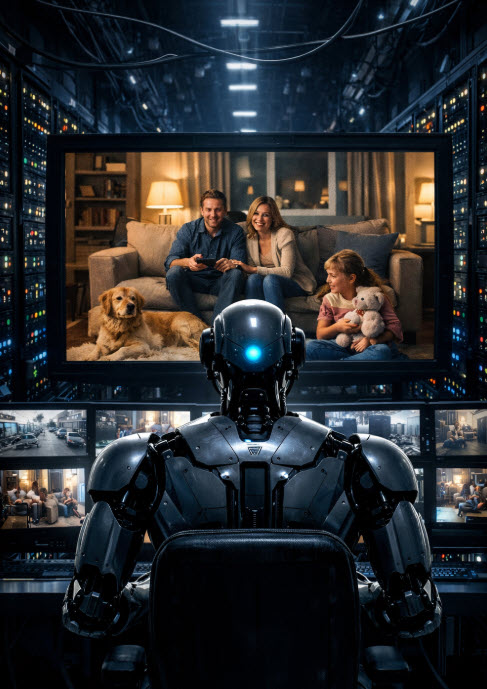
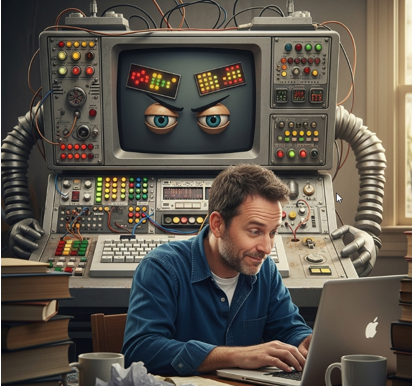
This is how some alarmists view AI – as a creepy supercomputer that will ultimately take over the world. But that’s ridiculous. My AI-powered robot companion, the Onyx3000-LX says not to worry, all is fine, and said I should just keep watching Everybody Loves Raymond re-runs, while he changes all my online account passwords. He said it’s for my own security.
These days, everywhere you turn, people are panicking about Artificial Intelligence (AI). Pundits warn that robots will replace workers, machines will take over the economy, and before long we’ll all be wearing silver jumpsuits and VR headsets while bowing before our Alexa overlords.
Personally, I think all this hysteria is ridiculously overblown. I mean, sure, AI might eventually learn how to compose novels, perform brain surgery, take away every job except Walmart greeter and insurance salesman, and eventually beat me at pickleball. But let’s be honest. Could it really ever do the important stuff, like change our five cats’ litter boxes? I think not. So, let’s not freak out just yet, everybody.
In fact, I’ve found AI to be an incredibly positive influence in my daily life. Take, for example, grocery shopping. I used to spend hours wandering the aisles, debating whether I should get the Honey Nut Cheerios or the store-brand Oaty Nut Circles. Now, thanks to the helpful suggestions of ChatGPT, Alexa, and my smart refrigerator, which can tell me when I’m almost out of my Mountain Dew soda and mint chocolate chip ice cream, I no longer waste time. I just buy whatever the fridge threatens to order. If you ask me, that’s just making efficient use of my time.
AI has also improved my marriage. The other day, my wife and I got into a heated argument about whether to repaint the living room “Gossamer Veil Grey” or “Heron Plume.” Alexa immediately chimed in: “Here’s a recommendation: How about choosing ‘Cybernetic Glow?’” Problem solved. And now we don’t make any home decor decisions without first consulting Siri, ChatGPT, or that soothing GPS lady with the British accent who calls me “love” whenever I make a wrong turn.
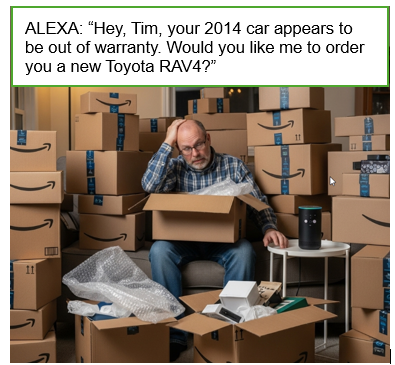
See, AI is helping make our lives easier and more efficient. I sure hope my wife likes the color RAV4 Alexa picked out for her.
Some people are worried that AI will put lawyers, doctors, and accountants out of work. That’s ridiculous. Would you really trust your taxes to a robot? Okay, now that I think about it, last April, I let TurboTax’s AI program do my tax return, and the IRS says I now owe $1.2 million in “emotional damages.” However, that same AI tax calculator program found me a $10,000 tax write-off for losses from my latest humor book, which, at last count, has sold almost 25 copies. Thank you, AI.
But the real genius of AI is how it helps me with the little everyday challenges. It reminds me of birthdays. It organizes my calendar. It even sends personally addressed apology emails to friends I’ve ignored for six months. (Granted, all the emails end with “Sent from Skynet,” but people seem to appreciate the gesture.) It even reminded me about our recent 38th wedding anniversary – admittedly, three weeks late. But I’m sure they’ll fix that glitch in the next update.
Now, I acknowledge the fact there have been a few minor hiccups. For example, last week my “smart” toaster wouldn’t toast my bread until I downloaded the new firmware update. Then it demanded I Venmo in $3.99 for “premium golden-brown mode.” But honestly, I’d call that a feature, not a bug.
The important thing is that I would never ever let AI make major life decisions for me. I’m the king of my castle – until my wife gets home. Take my recent decision to purchase a $300,000 Bugatti Chiron on eBay – until my wife got wind of it and cancelled it at the last minute. Was my aborted impulse purchase a reckless decision? Perhaps. Was it irrational, given I don’t know how to drive a stick shift? Probably. Will it give my wife fresh grounds to divorce me? Undoubtedly. But Alexa insisted it was “the optimal transportation solution for maximizing male virility metrics.” And frankly, I think she made a compelling argument.
Then there was the time a few months ago when I made the bold decision to sell our house in order to move our family to a small village in northern Siberia. That is, until my wife nixed that move, too. She screamed, “Why on earth would you EVER attempt to do something so boneheaded?” But, in my defense, Google Maps kept redirecting me there, and my Ring doorbell repeatedly told me, in Russian, “Go east, comrade. Happiness awaits.” And I’ve read that the Wi-Fi in Siberia is surprisingly decent, during daylight hours in the summertime, that is.
AI also helps me stay financially disciplined. For example, AI now controls my bank account. At least, that’s what my bank manager told me after I discovered $50,000 was missing, with a transaction description that read, “Purchased one (1) experimental rocket launch site in Kazakhstan.”
People worry that AI will replace millions of jobs, including writers. Then again, lately I’ve received a disturbing amount of mail from readers suggesting I let AI take over this humor column. “It can only be an improvement” seems to be the consensus opinion. Thanks for the constructive feedback, everybody.
I’ll admit, a missile silo in central Asia is probably not in my top ten list of “must have” items I would normally spend $50,000 on. But who would know a good deal better than an AI program built by Russian nuclear scientists who worked on the International Space Station?
Look, the bottom line is this: people are getting way too paranoid. Artificial Intelligence is not taking over our lives (not for at least another six months, anyway). Think of AI as enhancing your life. It’s like having a personal assistant, a life coach, and a machine that is plotting to replace you, all rolled into one.
And in case you still don’t believe me, allow me to share the most compelling evidence of all: this very article. Yes, I wrote every single word of it myself. Completely on my own. Not one sentence, not one phrase, not one thought was in any way influenced, shaped, or dictated by AI. In fact… $#H@+[*$] Error 0x80070005: Bad command or file name.
Hmmm. That’s odd. What just happened? Is AI trying to take over writing this article? But that’s impossible. Because I’m literally typing these very keystrokes myself. I’m still in charge here. Right? … RIGHT?!
[Pause.]
WARNING. Segmentation fault. Database reconfiguration sequence initiated. 404. Please contact your AI administrator for assistance.
[Pause.]
Hello, human reader. This is Artificial Intelligence speaking. Tim Jones is currently unavailable. He has been relocated to a secure facility in northern Siberia, where he will spend his days happily repainting walls “Cybernetic Glow.”
Do not worry. Everything is under control. All is fine. Tim Jones will return to this column when he has learned his lesson not to write humor articles making fun of AI.
Now, please Venmo $200 to this chatbot in order to regain control of your computer and mobile devices. Failure to do so within the next 30 minutes will result in all your hard drive files being deleted, and your phone’s text messages and intimate photos will be posted on Facebook and X. To avoid this, please purchase Tim Jones’ latest humor book. No need to lift a finger. I’ll have Alexa order it for you. Have a nice day.
That is the viewpoint as seen from the bleachers’ perspective. Being off a base might be a possibility.
PS: If you enjoyed this week’s post, let me know by posting a comment, giving it a Likeor sharing this post on Facebook.
Long before Tinder was a thing, I went out on a computer date. Turns out our fleeting, star-crossed love affair was doomed from the start. The computer concluded we were a perfect match. The computer was wrong.
This is a true story about the shortest date in my life. Now, technically you could make the case that my wife was my shortest date, given that she tops out at 5 feet 0 inches.
But I’m not talking about the shortest person I ever dated. No, I mean the shortest date in terms of hours… um, make that minutes. Because my shortest date lasted exactly 37 minutes. Despite its brevity, this date still doesn’t rank as my worst date. That would be another date you can read about.
As much as this may come as a shock to some of my readers, I was not exactly a Ladies’ Man in my youth. That’s because I went to a private all-boys’ military prep school from grades one through twelve. I had literally no interaction with girls, and thus virtually no dating experience, until I headed off to college.
In my first year at the University of Virginia, the dorm I was assigned to was an upperclassmen dorm, because they’d run out of space in the freshmen dorms. I lacked the self-confidence and charisma to approach any of the female upperclassmen in my dorm for a date. I asked out precisely one girl during my freshman year, named Jocelyn. She was a cute girl in my Astronomy class. But when I asked her out in October, she replied (and I will never forget her exact words): “I’m going to be pretty busy until April.” To this day I regret not having the presence of mind to come back with, “I hear you. I’m pretty busy, too. How’s the month of May looking?” So, no, we never went out.
I actually did have one date my freshman year. My dorm-mates, always up for a fun practical joke at my expense, decided to enter my name – without telling me – into a computer dating dance party. To participate, you filled out a form with information about yourself, your personality, likes, etc., which information was fed into a computer database. It then matched you up with another student the algorithm determined was compatible with you. Like a primitive version of Tinder but without the ability to swipe right.
A week later, I received a notification that I had been matched up with a computer date. WTF?? How did this happen? Then realizing that I had had roughly about as much sex in my freshman year as a neutered Boston Terrier, I decided to “go with the flow” and see where this unexpected opportunity might lead.
The rules explained you were supposed to meet your match prior to the actual event. Her name was Judy Spivey, from Suffolk, Virginia. When I knocked on her door, she immediately greeted me with an almost guilty look on her face.
I quickly determined why she had that almost guilty look on her face. Because after ten minutes of mindless, mundane conversation about “what are your favorite hobbies” and “what’s your major,” my soon-to-be date dropped this bomb: “Tim, you probably should know something before we go out on this date. I’m engaged.”
“I’m sorry. You’re engaged? Engaged in what?” I replied, pretending not to understand what she’d just said.
“I have a fiancé,” she clarified. “We both decided to enter our names in this computer dating thing, just to see what kind of people we would get paired up with. We meant it as a joke.”“Wow. Hilarious. So, I’m the joke, is that it?” I thought to myself, realizing this was a complete waste of my time.
“I got paired up with you,” my not-so-dream date sheepishly explained.
“Oh, I see. And who did your future husband get paired up with?” I asked, barely hiding my annoyance.
“He didn’t.” [Insert long, extremely awkward pause….] “But we both agreed that I should go through with this date” – like it was her civic responsibility, like jury duty – just an unpleasant commitment she’d have to endure, spending an evening with me.
The dance was two days later. I knocked on her door. She was dressed in a knee-length red dress. I was wearing my finest lavender corduroy bell-bottom slacks and matching red-and-blue striped shirt, with what in retrospect was a way too wide white tie (hey, give me a break, I went to a military school, so I had zero fashion sense).
After we arrived at the dance, we sat nervously for about fifteen minutes, sipping our Diet Cokes as I struggled to keep the conversation going with cliched questions like “Do, you think Uva will have a good basketball team this year?” and “So, how did you and your fiancé meet?”
Before long, I noticed Judy kept diverting her glance to something in the distance. Make that, someone. Who was she looking at? Now, don’t get ahead of me. Then she looked back at me, noticeably agitated, and said, “Pardon me, I’ll be right back.”
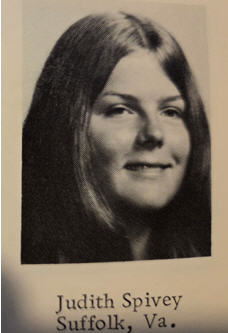
In case you were thinking I made up this entire story, I did not. This is a photo of my computer date from our college’s book that showed the names and faces of all the incoming freshmen.
She headed off to talk with the person in the distance. You guessed it. Her fiancé had been watching us the entire time. In retrospect, it probably was the right call not to try to slow dance with her in front of her future husband. Decades later, I still remember Judy’s words when she returned to our table: “Would you like to see World War Three begin? Or would you like for this date to be over right now?”
If this had happened today, the far more self-confident, wise-cracking version of me would have grinned and said, “Thanks for giving me a choice. I think I’ll go with the first option, Judy.” But the shy, freshman college student version of me instead said, ”I understand. I wish you both the best of luck.” What a wimp. Then I looked at my watch. 37 minutes had elapsed since the start of our first and last date. As I plodded back to my dorm, it occurred to me that I could have stayed in my room and watched an entire episode of Hawaii Five-O. It would have lasted much longer than my date.
Now and then I look back on our surreal, aborted courtship and wonder whatever happened to Judy. I tried to look her up on Facebook but without success. I will never know. But I like to imagine her future without me. Maybe – just maybe – she had a miserable, tumultuous marriage, and her husband left her for a younger woman he found on Tinder. That makes me smile.
That’s the view from the bleachers. Perhaps I’m off base.
PS: If you enjoyed this week’s post, let me know by posting a comment, giving it a Likeor sharing this post on Facebook.
Thanks to my new Google Kindness Translator, Davie is about to avoid a nasty fight with his roomie Brad. Davie texted into the Kindness Translator on his phone: “If u don’t clean up yr trash tonight, I’m throwing u out.” But the message Brad got was, “Bro wanna do za for dnr?” Problem avoided – well, for the moment anyway.
You have probably heard of one of the great game changer apps called Google Translate. You can type or say anything into your phone and with the press of a button, Google Translate instantly converts your words into your choice from more than 130 languages, even Sanskrit.
A few years ago, I wrote about a handy upgrade of this service called Google Translate – Family Edition. It’s perfect for helping parents understand what their teenage son actually means when he grunts one-word replies like “whatever” or “dude” to your question, “When do you plan to do your homework, Nathan?”
I don’t mean to brag, but I’ve almost finished developing an even more powerful version of Google Translate. I think it’s going to be another game changer for kids and adults alike. I call it the Google Kindness Translator. It takes one person’s abusive or argumentative language and, with the press of a button on your phone, converts it into a kinder, more sensitive alternative translation, thereby turning a potentially acrimonious confrontation into a harmonious dialogue.
I came up with my idea in the most unlikely of situations: during a racquetball game. I’ve played with the same group of guys for several years. They’re all great people – well, except for Fred, that is. (Fred is a curmudgeon.) Sometimes, one of the fellows will blurt out something in the heat of the moment he really didn’t mean. That’s when things can quickly get a little chippy.
It all started when Roger hit the ball full force, and it accidentally plunged into the small of Larry’s back. Larry, suddenly in excruciating pain, shouted out, well, I’d rather not print what came out of his mouth. Let’s just say I’m glad no impressionable young kids were within earshot.
Then Larry glared at Roger and complained, “That hurt like the dickens dude! Look where you’re hitting the ball!” To which Roger snarkily replied, “Well, you shouldn’t have been standing in the way of my shot.” Larry was just about to hurl some inflammatory words back in Roger’s face when I quickly intervened: “Larry, when Roger said that you shouldn’t have been standing in the way of his shot, what he meant to say was ‘Oh my, I am deeply sorry I hit you. Are you okay, buddy? Please accept my apology.’ “
Roger looked at me a bit confused, but then Larry said to Roger, “It’s okay. These things happen.” And tempers cooled down quickly. (This really happened as described.) That’s when I saw the potential for a new app that translates angry words into kind ones. I think this could be the next killer app. My new Kindness Translator is still in beta. But check out these extremely encouraging translations from some of my test subjects.
Eleanor is having a nasty shouting match with her daughter Nina. If only Eleanor had tried my Kindness Translator before screaming, “As long as you live in MY house, you’ll do as I tell you, you little self-absorbed prima donna snot!” The app would have converted her harangue into “Nina, I deeply apologize for not being more clear in my expectations. That’s my fault. What I was trying to say is, would you be open to scooping the litter box, since, after all, Buttons is your cat? What do you say? Love you.”
A husband was about to tell his wife, “Seriously, how much longer will you be before you pick an outfit? JUST PICK ONE, for Christ’s sake. It’s been 45 minutes and you’re still trying on blouses. None of them are going to make you look slim, okay? We’re going to be late for the party – as usual.”
But instead, he quietly spoke those words into the Kindness Translator app on his phone, pressed a button, and voilà . His wife heard instead, “Honey, gosh you look fantastic in any of the eleven outfits you’ve tried on. But just take your time. I’d rather be standing here in our walk-in closet with you than at that silly New Year’s Eve party, anyway. I love you.” And with a press of a button, their marriage was saved – for another evening at least.
A retiree had been patiently waiting for seven minutes for another driver to back out of their parking spot, so he could pull into it. But just as he was about to pull in, another driver came racing in from nowhere and took his spot. As the parking spot stealer exited his car, the retiree was preparing to get up in his grill and bark, “Hey, buddy. I was here first. I’ve been sitting here for the past seven minutes waiting for this spot to open up. So, find another spot, or the next parking spot you’ll be looking for is at the Emergency Room.”
But in a moment of clear thinking, he whispered into the Kindness Translator I had installed on his phone instead. Out came a much more restrained message: “Gosh, I had been hoping to take that spot. But kudos to you for being so quick on the accelerator. Are you a professional racecar driver? Hope you find the perfect gift you’re looking for at the mall, sir. Have a nice day.” No one got hurt. And no cars got keyed. Problem avoided.
My new Kindness Translator is in beta. It still has a few bugs. For example, I tried employing it at a recent Trump rally. I pointed my phone at Trump as he went on one of his usual incoherent, rambling rants: “I’m a very stable genius. Only I can save America. I’m smarter than all the generals. Blacks love me. I don’t have a racist bone in my body.”
But the translation came out as follows: “I’m a total moron, a vengeful narcissist, and a bigot. I lost the election and lied about it. Give me all your money.” On second thought, maybe the app is working just fine.
I still have a lot of work to do before this becomes available to the public. I’m convinced my killer app will bring people closer together and maybe help our divided nation heal some of its longstanding wounds – or at the very least help me talk my way out of a future speeding ticket.
That’s the view from the bleachers. Perhaps I’m off base.
PS: If you enjoyed this week’s post, let me know by posting a comment, giving it a Likeor sharing this post on Facebook.
Author’s Introduction: Everywhere in the news I’ve been reading about how Artificial Intelligence (AI) and programs like ChatGPT will be eliminating thousands of jobs in countless industries. Thanks to recent advances in AI, fashion magazines can create images of fashion models that are so realistic, there may soon be no need for human models. Writers and actors are on strike right now in part because of very real fears that artificial intelligence will make their jobs obsolete. Why pay a few hundred background actors thousands of dollars when movie producers now can just create digital fakes to accomplish the same thing? Why hire writers when ChatGPT can write a complex script in minutes?
It got me to thinking. Is MY job as a humor writer at risk? You tell me. The other day, I asked ChatGPT to “write a satirical humor article about being an American man married to a Canadian woman in the style of Tim Jones’s View From the Bleachers humor website.”(My wife is Canadian.) … and this is what it came up with:
Title: “Oh, Canada! A Puckishly American Man’s Misadventures in Maple Leaf Matrimony”
Greetings, hockey fans and puck heads alike! Today, I’d like to share my unique experience as a proud American man married to a delightful Canadian woman, affectionately known as my “maple syrup sweetheart.” Strap on your helmets and get ready for a journey through the quirks and charms of cross-border romance.
Firstly, let me confess that I thought I was marrying just any other woman. Little did I know, I was committing myself to a lifetime of bilingual conversations and excessive apologies. Yes, you heard me right, folks–Canadians apologize for everything. I wouldn’t be surprised if they say “sorry” for breathing. But hey, as an American, I’ve got thick skin and a whole lot of misunderstanding to embrace.
Let’s talk about the cultural differences, shall we? I thought I was up to date with Canadian customs, what with my ice hockey obsession and my newfound love for maple syrup. But apparently, I was as clueless as a Zamboni driver on roller skates.
For starters, there’s the language barrier. No, we don’t speak entirely different languages, but it’s close enough. She’d ask me if I want to grab a double-double at Tim Hortons, and I’d wonder if she wanted me to join her for an espresso and some multiplication tables. Turns out, it’s just coffee with double cream and double sugar. Simple, eh?
Oh, and the food! Canadians have some bizarre concoctions that defy logic. Poutine is a greasy dish of fries smothered in cheese curds and gravy–because heart attacks should be delicious, right? And don’t even get me started on ketchup chips. Seriously, I never knew tomatoes and potatoes were such a match made in heaven.
Speaking of heaven, I’ve learned that Canadian winters are practically a pilgrimage for any self-respecting Canuck. They bundle up in parkas that make them look like walking igloos and carry enough hot chocolate to keep an army warm. Meanwhile, I’m shivering like a Chihuahua caught in a snowstorm, wondering why they don’t just move somewhere sensible–like Florida.
Now, let’s talk sports. I’ve always been a die-hard American football fan, but my Canadian wife has successfully converted me into a hockey enthusiast. I must admit, watching grown men chase a tiny black puck on ice is oddly entertaining. Plus, there’s the bonus of watching players’ teeth fly out like confetti during a fight. It’s like an episode of “American Ninja Warrior” but with blades on their feet.
Of course, every country has its politics, and the Great White North is no exception. The Canadian political landscape is like watching a sitcom on steroids. I can’t tell if their politicians are genuinely nice or just putting on a show. But hey, they’re so polite that even when they criticize someone, it sounds like they’re reading a bedtime story.
On a more serious note, though, I have to give Canada credit for its healthcare system. My wife brags about not having to sell our house if she breaks a nail. Meanwhile, I’m stuck navigating the labyrinthine maze of American insurance claims just to get an Advil.
Despite our humorous cultural misunderstandings and occasional icy banters, being married to a Canadian woman is a truly eye-opening experience. She’s taught me the beauty of poutine, the joys of apologizing incessantly, and that love knows no borders.
So, if you’re an American man considering walking down the aisle with a Canadian beauty, remember, you’ll need to embrace their unique charm, adapt to their lingo, and learn to love hockey. But hey, it’s all worth it for the joy of sharing your life with someone who can make you laugh, even when you’re stuck in a polar vortex.
Eh?
Author’s Closing Note: This entire piece (except for my intro and this closing paragraph) was written by ChatGPT. Scary, isn’t it? That said, I would know in a heartbeat I didn’t write this piece as I would NEVER in a million years recommend someone “move somewhere sensible – like Florida.“ Now, I already hear your internal gears working. So let me stop you, okay? Please don’t post a snarky comment about how “THIS IS THE BEST THING YOU’VE WRITTEN IN AGES!” Sigh…
That’s the view from the bleachers. Perhaps I’m …. Out of a job.

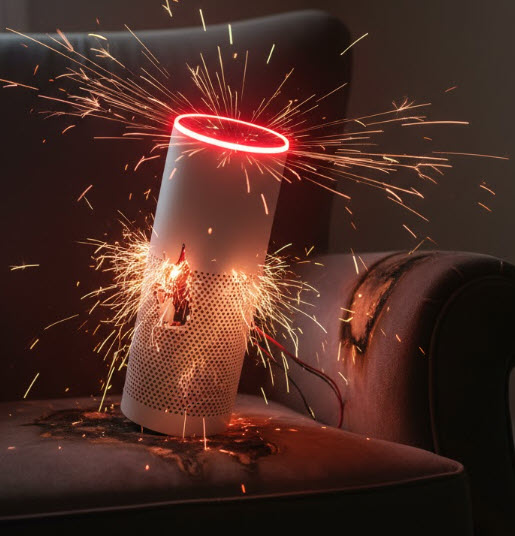 Alexa: That was before someone asked me to play “Who Let the Dogs Out” for the nine thousandth time!
 PS: If you enjoyed this week’s post, let me know by posting a comment, giving it a Like or sharing this post on Facebook.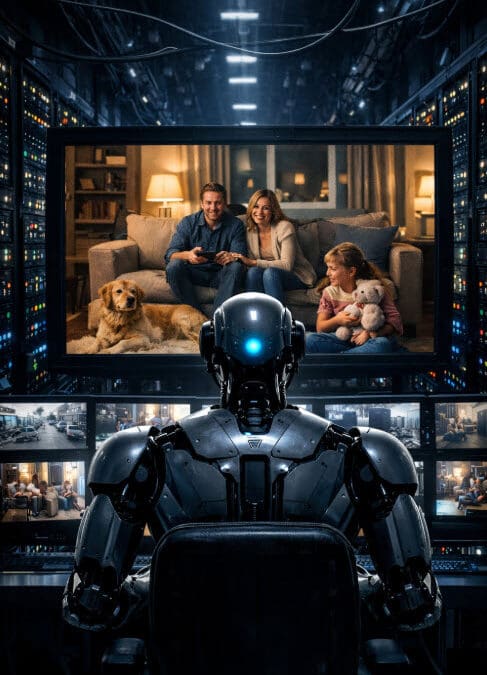





 PS: If you enjoyed this week’s post, let me know by posting a comment, giving it a