by TEJ | Sep 7, 2015 | Parenting and Family humor
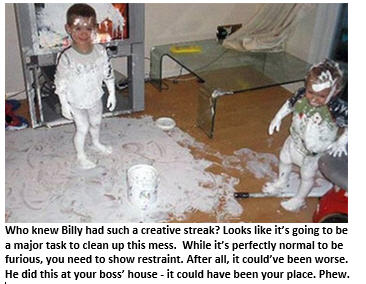 Years ago, I had this reckless notion that something was missing in my life which could only be filled by having kids. So we started a family – and got so much more: eight years of Raffi songs, 800 trips to sports practices (and the occasional trip to the ER), $6,000 in orthodontia bills, and a child-proofed house, every square inch of which perpetually resembled a FEMA disaster zone.
Don’t get me wrong – I love our daughters more than anything in the world – with the possible exception of bacon. But it didn’t take long to discover that despite the significant gap between my toddlers and me in earning potential, overall intelligence, and ability not to drool on everything with which I came into contact, I simply was no match for my kids. They routinely wore me out – usually by the time they dumped a bowl of Raisin Bran on each other – a daily 7am ritual.
As a parent of two boisterous young girls, I quickly came to two conclusions: First, the interior of the VCR makes an ideal place to hide daddy’s slice of apple pie; and second, being a parent was going to require Herculean levels of patience. Being a good parent means having the maturity to resist saying the first thing that pops into your prefrontal cortex when your eight-year-old microwaves your cell phone. You need to suppress the urge to blurt out, “Jesus Christ! What the hell were you thinking, spraying the cat with the purple paint, you little twerp?” Such an outburst could permanently damage your precious angel’s delicate self-esteem – much like my angel permanently damaged our precious leather couch with a stick figure etching of her daddy.
Shortly after our girls acquired rudimentary speech, I learned a valuable lesson: Never use foul language in front of young children. When my eldest was barely three, I caught her wielding my $500 Titleist driver into the trunk of our cherry tree, “just like George Washington, Daddy!” While she hadn’t yet mastered conjugating a sentence, she had, to my surprise, absolutely no difficulty reciting back to mommy the entirety of my panicked outburst – verbatim: “Mommy, Daddy said, ‘Holy shit. Look what you’ve done to my club!’ What does ‘shit’ mean, Mommy?”
(more…)
by TEJ | Apr 15, 2015 | Parenting and Family humor, Political humor
 When it comes to parenting, I don’t always make the best decisions. I’m not always sure what the right thing to do is in a difficult situation.
Like the time our elder daughter begged and pleaded with me to let her drive the car to the mall. It was a sunny day. Traffic was light. And she had behaved extremely well all week long. So against my better judgment, I said okay. Two minutes later, she smashed the car into a stop sign barely 100 yards from our driveway. A part of me can’t help but wonder whether in retrospect I made a mistake giving in to the incessant pleadings of an eight-year-old to drive my minivan.
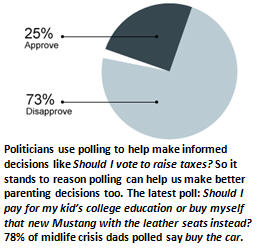
Sometimes my wife questions my ability to make the right call. Heck, she rarely listens to any of my opinions unless at least four complete strangers tell her the exact same thing – which got me to thinking: maybe the way for me to make better parenting decisions is to poll the opinions of total strangers.
In the most recent presidential election, the polls were incredibly accurate forecasters of people’s voting preferences. Nate Silver’s 538 blog accurately predicted the Electoral College winner in all fifty states. Politicians use polls all the time to help them decide how to vote. Should we legalize gay marriage? Poll your constituents. Should we cut defense spending? Do a poll. Should we ban hurricanes during the last week of a presidential campaign? (97% of Republicans resoundingly voted yes.) (more…)
by TEJ | Mar 11, 2015 | Parenting and Family humor
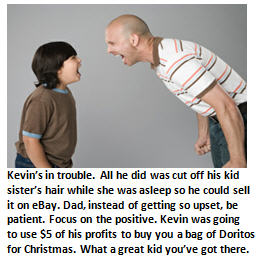
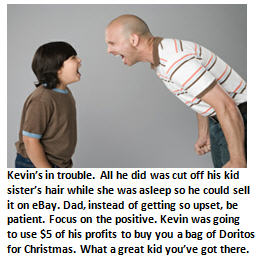 If there is one thing I’ve learned as a parent, it’s that in the end, your kids will crush your dreams, ignore your advice, join a biker gang, and blame you for everything.
But if there is a second thing I’ve learned, it’s that you need to be positive. As you know, outside of my immediate family, I am considered a parenting expert. My latest book, A Positive Parent’s Guide to Loving Your Child, even if They’re an Evil, Twisted, Unmotivated, Narcissistic Demon Seed Hellion Who Will Never Amount to Anything is helping millions of frustrated parents around the globe deal with their challenging child. The key? Remain positive at all times.
This week, I dip into Dr. Tim’s Mailbag, to share how you can successfully apply my powerful patent-pending positive parenting process to help your own challenging child blossom to almost one quarter of their God-given potential. (more…)

by TEJ | Nov 13, 2014 | Parenting and Family humor
 Recently my college-age daughter Rachel emailed me, asking for help with a problem. Such an event – being rarer than a sighting of Halley’s Comet – calls for all-hands-on-deck-full-throttle parental engagement. “I’m there for you, Rachel.”
Thus began an email exchange that I am proud to say profoundly impacted my daughter and our relationship. Her gratitude for my sage advice is evidenced in her words that, well, she couldn’t even put into words how helpful I was.
Rachel: Hey, Dad. Wanted to ask you something. My boyfriend Brad and me had a fight. I saw him with my best friend Brianna. They were holding hands. He says she’s just a friend, but I think he’s lying. Should I confront him?
Me: Thanks for your email, Rachel. I am happy to help. Frankly, this is a common problem for many young people. In fact, your mom often struggled with similar issues when she was your age.
Here are my suggestions. First, never start a sentence with a verb unless it’s a command. When you write “Wanted to ask you something”, the reader is left wondering: Who wanted to ask me something? My daughter? My boss? A strange man in a tall hat? You never want to leave your reader guessing.
Also it’s not “Brad and me had a fight.” It’s “Brad and I.” Me is the objective form of the first person pronoun. In this context, however, you need the subjective form.
Rachel: Whatever, Dad. I don’t think you understand. I think Brad is cheating on me. Last nite, I texted him. No reply. No idea what he’s up 2. What should I do? (more…)
by TEJ | Sep 16, 2014 | Parenting and Family humor
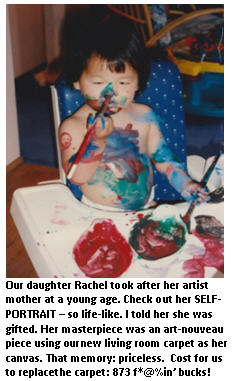
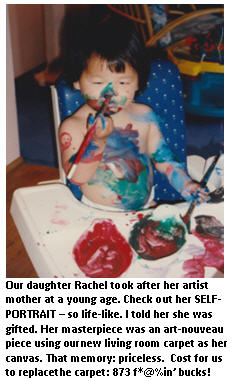 I love my kids. That’s why, when they were young, I made a point to lie to them every chance I could. As any experienced parent knows, you need to lie to your young, impressionable children to help prepare them for their lives as adults – and to help you forge a trusting relationship with them.
Parents who care about their young children start lying to them early in their formative development – ideally while their offspring are still in the womb. Don’t wait until they’re in middle school. By then your chronic pattern of honest communication will likely have caused irreparable damage.
There are many reasons we adults lie to each other: to get out of cleaning the garage despite your wife’s nagging about it for the past three months; to deny that you scarfed down the last piece of your wife’s birthday cake; or maybe to hide the fact that you were really golfing when I, er, I mean you, told the wife you were helping a buddy move. Of course, there are also bad reasons for lying, but at the moment, they escape me.
But when it comes to children, caring parents know that lying is a way to avoid crushing their kids’ self-esteem. It’s not your job to destroy your child’s hopes and dreams by dispelling the myths of their childhood. That’s their future therapist’s responsibility. Your job is to keep telling your kids whatever you need to, to get them to behave, brush their teeth and maybe, just maybe, not kill the family cat, Bonkers.
(more…)