
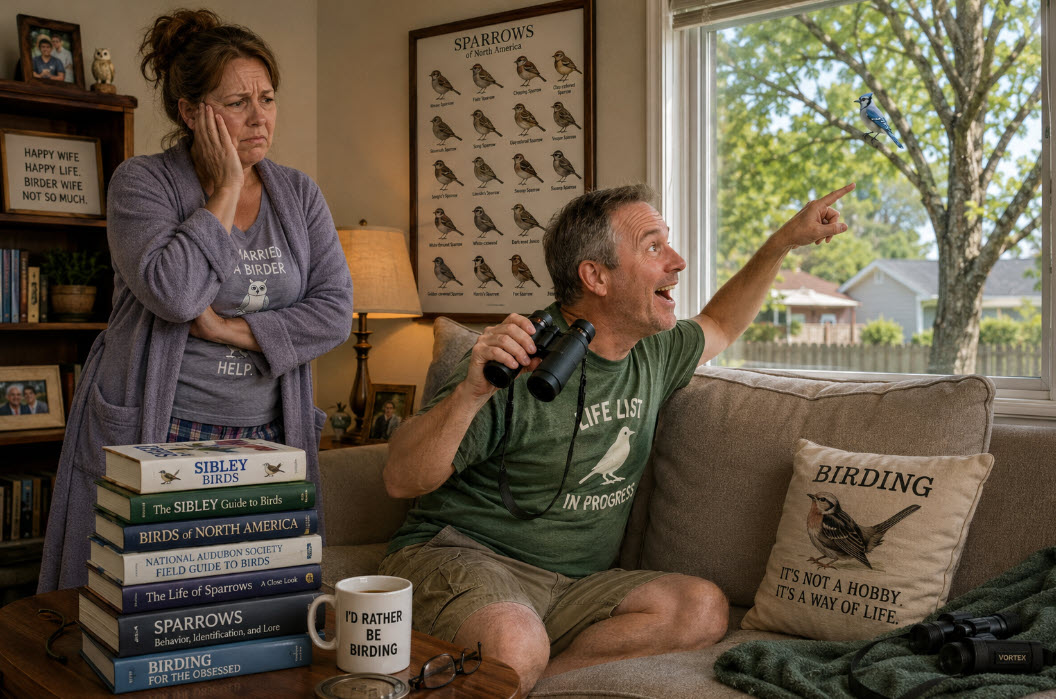
Henry and Marge have been married for 27 years. Unfortunately, for 9 years, Henry’s been a birder. He’s spotted a jay. But he’s not sure if it’s a California Scrub Jay or a White-tailed Jay. She’s thinking, “Who the f*** gives a crap what type of jay it is!”
As a nationally recognized unlicensed behavioral psychologist who has spent nearly three decades studying unusual human habits, I have witnessed countless troubling obsessions. I’ve seen adults spend $14,000 on virtual farm equipment in online games. I’ve counseled men who believed professional wrestling was real. I’ve even met individuals who voluntarily joined local pickleball association boards. (What were they thinking!)
Yet none of these compare to the rapidly growing epidemic currently sweeping suburban America. I’m speaking, of course, about birding.
For those unfamiliar with the term, a “birder” is not someone who enjoys an occasional glance at a Robin while mowing the lawn. No, birders are individuals who become fascinated – some experts would say chronically obsessed – with obscure birds with multi-syllabic names like the Northern Black-Hooded, Double-Tufted, Wing-Crested, Hooked-Tail Sparrow. The problem is worse than you think.
According to recent studies, married men who think Birkenstocks with knee-high black socks is a good look and who have limited social lives appear particularly vulnerable. The warning signs often begin subtly. Perhaps your husband points out a bald eagle circling overhead (unless you’re in New York City, in which case it’s more likely just another pigeon). Then he purchases a bird feeder. Before you know it, your husband is waking up at 4:15 AM on a Saturday, covered in camo netting, to sit in a swamp, hoping to catch a glimpse of a breeding pair of North American White-Crested Sapsuckers.
How do you know if your husband has crossed the line from a casual nature-lover into a full-blown avian psychotic? Look for these critical warning signs:
First, listen to his vocabulary. If your spouse goes on at length describing the minor, indistinguishable plumage differences between the Kentish Plover and the White-Faced Plover, seek psychiatric help immediately. There is no rational reason a grown man should care about a plover’s feathers.
Second, monitor his accessories. If he has a pair of high-powered, military-grade binoculars strapped around his neck at all times – including while watching TV, driving the minivan, or taking a shower – this is not a fashion statement. It is a cry for help. If your spouse has obvious binocular tan lines around his neck, it’s time to panic. He may be beyond saving at this point.
Ordinary men discuss sports scores, riding mowers, or why their team’s prospects to “go all the way” look much better next year. Birders suddenly begin saying things like, “I heard a Black-Throated Gray Warbler this morning.” Or, “The snow geese migration patterns have been spectacular this year.” Or, “Quick! Get in the car! Someone spotted a rare Yellow-Bellied Something-Or-Other near the sewage treatment plant!” No rational person has ever uttered such phrases – or had any interest in being caught anywhere in the vicinity of a sewage treatment plant.
One of the most troubling signs occurs when family vacations become suspiciously bird-centered. Your spouse may believe you when you tell her you’re taking her for a quiet romantic weekend getaway. Then you arrive at a mosquito-infested marshland in the middle of nowhere because “a very unusual shorebird called the Lesser Bar-Tailed Godwit was reported there on Tuesday.” Some marriages never recover.
So, what should you do if you suspect your spouse has become deeply involved in birding? First, remain calm. Avoid direct confrontation (or direct eye contact). Do not ridicule his collection of birding field guides or expensive birder apps. You may be tempted to ask why he owns seven books that all appear to contain identical pictures of sparrows. Resist this urge.
He will have explanations. Lengthy explanations. Annoyingly boring, excruciatingly detailed explanations. Instead, gently encourage alternative activities. Suggest hobbies generally considered more normal among middle-aged men, like high-stakes sports gambling, fantasy football, arguing with Trump supporters on Facebook, day trading, or going to strip clubs with male friends in search of hookers.
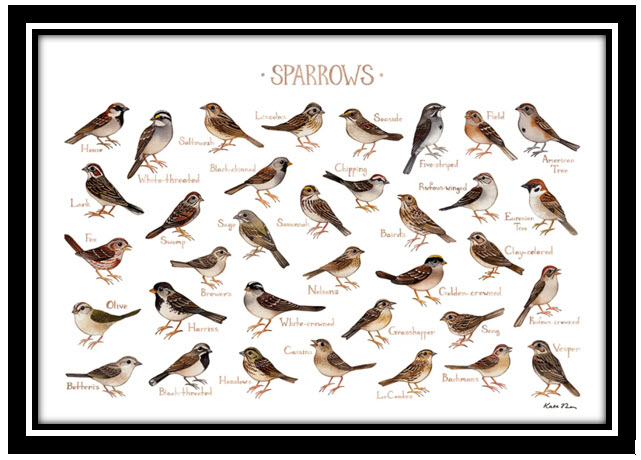
This is a chart listing some of the more popular North American Sparrows. Did you know that there are 60 different species of sparrows in North America alone? How many species of sparrow can you name? If you can only name one – SPARROW – congratulations, you’re not a birder. You are a normal, sane person, with your priorities in order.
Granted, finding male friends willing to accompany a committed birder can be challenging. Many friendships end abruptly after the third consecutive conversation about the migratory patterns of the Black-Capped Chickadee.
Try inviting other couples over at your peril. Birders tend to struggle in social settings because they frequently interrupt conversations to identify birds outside the window. “Honey, pay attention. Karen was telling us about her hip replacement.”
“I understand, but that’s definitely a Red-breasted Nuthatch.” Turns out he was right, but that’s beside the point.
You can also attempt gradual rehabilitation. If he spends four hours watching birds every Saturday, reduce it to three and a half. Replace the remaining thirty minutes with sports highlights or yelling at professional golfers on television. Recovery can be a slow, arduous journey back to sanity.
In severe cases, professional intervention may be necessary. The National Association for Concerned Spouses operates a confidential bird-wife support hotline at 1-800-NO-MO-OWLS. Trained volunteers stand by 24 hours a day to listen compassionately while you explain why your husband drove 200 miles to observe a bird that looks nearly identical to twelve other birds he’s already photographed over 200 times.
Remember, you are not alone. Thousands of families are affected each year. But let me help you put this crisis into perspective. Birding, while irritatingly nerdy and mind-numbingly boring, is generally harmless – unless your spouse attempts to pet a raptor. In fact, it could be much worse. Your husband could have become obsessed with model trains.

See? It could be a lot worse than having a birder for a spouse. Your husband could have taken up trains as a hobby and taken over the garage… then the basement… then the living room…
With train enthusiasts, sooner or later, the entire garage gets covered wall to wall with train paraphernalia. Then the basement. Before long your home starts looking less like a mid-century two-story colonial and more like an 1850s pioneer village complete with tiny blacksmith shops, miniature livestock, and a thematically era-inconsistent model drive-in burger shop circa 1962, which he got on sale for only $450.
Before you know it your husband is walking around all day sporting an 1870’s era train conductor’s outfit complete with a genuine conductor’s whistle – which he blows at full volume every time the train comes into the station. If you notice your husband has run a stretch of model train tracks across the bed headboard in your bedroom, that’s a good indicator it’s time to contact a divorce attorney.
Compared to that, a few binoculars and an unhealthy interest in woodpecker mating habits doesn’t really sound so bad now, does it? So don’t freak out. And if your spouse suddenly shouts, “Quick! Grab the camera! A rare tufted thingamajig just landed in the maple tree!” Well… At least he’s outside getting some fresh air, in his favorite pair of Birkenstocks.
That’s the view from the bleachers. Perhaps I’m off base.
 PS: If you enjoyed this week’s post, let me know by posting a comment, giving it a Like or sharing this post on Facebook.
Subscribe to my View from the Bleachers YouTube Channel and request notifications to see my latest videos. And check out my latest book, THE SECRET TO SUCCESS AND HAPPINESS (is Something I Have Never Figured Out. I’m Open to Suggestions)









Actually the Black-Capped Chickadees in our area don’t seem to migrate. There’s enough food for them here all year — oh no, guilty as charged!! — M
I am David and I am a grade 2 birder (my scale 1-5 where 1 is just starting and 5 is a bird-maniac). I plan for months to pick up a good supply of seed – I plan 30 minutes to pick up my wife’s coffee creamer
Uh oh. I’m probably getting dangerously close to this, but fully expect my friends to do their jobs and rein me in before I go off the deep end!
Hi Tim,
There are probably many other interests that spouses might have that become obsessions. My husband was a NYGiant fan and would have to dress in Giant clothes before every game. There was no socialization happening during the games. Then —if they lost- there was a depression for days.