Corporations do a lot of things well, but one thing that some of them could use a little help with is how to say I’m sorry when they screw up. Historically, like George Bush, most companies are not very good at saying “I’m sorry. I screwed up.” Recently some very familiar names have been getting a lot of practice in the fine art of the apology: Toyota, BP, Goldman Sachs, Apple Computers, anyone who has ever held public office in the state of Louisiana, and for my friends in Seattle who follow baseball, the 2010 Seattle Mariners. You see, corporations aren’t perfect. They’re human, just like you and me (at least according to the U.S. Supreme Court).
As most of you know by now, I am an award-winning business expert. (And by award-winning, I’m referring to the time I won a white ribbon – fourth place – in my tenth grade business project for my idea of starting a company that sold over-priced coffee with fancy names in stores with dim lighting, smooth jazz and wireless Internet. Curse you, Howard Shultz.) I want to help those entrepreneurs who are planning to make a bone-headed business decision by offering you my expert counsel on the steps required to effectively apologize for your future mistakes.
Corporations don’t intentionally set out to anger and alienate their customers – unless they’re a healthcare insurance provider, that is. Usually it’s just that a good idea gets implemented poorly. Or some unintended consequences occur which nobody in the marketing department could have possibly anticipated. Like when that cereal company – whose name will be withheld so they won’t sue me – decided to do a promotion with a national hardware chain – whose name will be withheld so they sue me either – and they decided it would be a neat idea to include a packet of one-inch nails in every box of say, Fruit Loops cereal. Who knew that the folks in production would forget to actually put the nails in a pouch to keep them from separate from the actual cereal contents?
Below is the conclusion of our two-part series of Superstar Strategies for Super Sales Success, from the renowned Sales Coach to the Stars, Biff Biven, motivational speaker and author of the not quite best-selling sales primer Everything I learned about Sales I learned in Prison. In Part two, Biff reveals the remainder of his A to Z Secrets for Sales Superstardom, starting with the letter P.
If you missed last week’s Part One, or you just need a refresher on the letters of the alphabet, you can read it here.
Now back to the Biff Biven’s guest post, Part Two.
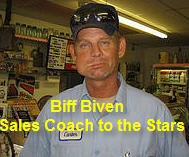
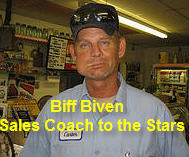
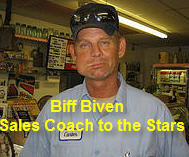
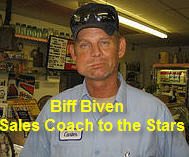
For much of my career I have been in sales management. The first thing any new salesperson learns is the ABCs of sales. You know – Always Be Closing. Turns out, this is a totally five minutes ago approach. I’m delighted to have veteran sales coach and motivational speaker Biff Biven take the helm this week as my guest blogger, to tell VFTB’s readers about the NEW ABCs of sales. That’s Biff on the left.
Biff is proud to say he came just 3 credits shy of graduating from Rebel Yell Elementary School in Biloxi, Mississippi. He is a renowned expert on direct sales strategies, having done direct selling for several decades (on and off, when he was not collecting welfare checks or serving time). Some of his achievements include direct sales roles with KFC, McDonalds (where he once met Ronald), Stanley Steamer carpet cleaner, and Shucks Auto Supply, to name just a few of the 37 Fortune 10,000 companies he has worked with over the past 35 years. He is perhaps most proud of his current role with Dominos, where every day he is personally responsible for driving regional sales (in his 1987 two-tone Ford Pinto hatchback).
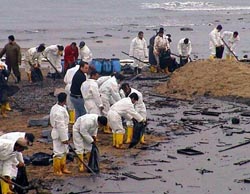
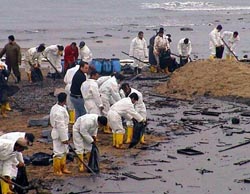
April 22, 2010 was Earth Day. But it was not a very good day for the earth – or for that matter, for BP. That’s the day the an explosion toppled over BP’s Deepwater Horizon oil rig in the Gulf of Mexico and the blowout preventer failed, causing the earth to begin leaking thousands of gallons of oil from 5000 feet below the surface of the Gulf. In a bit of irony, the original Earth Day was April 22, 1970, thirty years ago to the day of this year’s spill, begun in large measure in response to another oil spill caused from a blowout of a deep sea drill off the coast of Santa Barbara, California.
Last week, the Gulf oil spill disaster surpassed the 1989 Exxon Valdez oil spill as the worst environmental disaster in American history. BP (the initials, which formerly stood for British Petroleum, have been changed to stand for “Best Polluter”) has taken full and complete responsibility for the oil spill. And by “full and complete responsibility”, BP CEO Tony Hayward went on to clarify that the Deepwater oil rig was owned and operated by Transocean, which, he went on to say was responsible for the safety on the oil rig. According to The London Telegraph, Hayward further clarified BP’s full and complete responsibility by saying, “This was not our accident. This was not our drilling rig. This was not our equipment. It was not our people, our systems or our processes. This was Transocean’s rig. Their systems. Their people. Their equipment.”
Welcome to installment #61 in my periodic series of business lessons on how you can take your business to never-before-imagined levels of success. In this challenging economy, companies are forced to do more with less and continue to look for ways to squeeze efficiencies, often by means of painful layoffs and other draconian cost controls. I have a better idea: Hug your company’s way to success.
Recently the New York Times reported fascinating findings from a soon-to-be-published research study by scientists at University of California at Berkeley. They measured the level of physical contact between teammates in the National Basketball Association over an entire season. Their conclusion: Teams and individuals that hugged, high-fived and chest bumped their teammates more tended to outperform those that engaged in less frequent affectionate physical contact.
This week’s blog post is a guest post by Steve Fisher, the funniest person I have ever known personally. Steve is based in Prague, Czech Republic, where he works in the field of Corporate Communications. On the side, Steve has had acting roles in several films and television shows.
It is my pleasure to turn this week’s post over to my life-long friend. In his commentary, Steve asks, Have you read the fine print on those online agreements lately? You might want to take a second look before clicking “I agree.” (Continued below…)


 Corporations do a lot of things well, but one thing that some of them could use a little help with is how to say I’m sorry when they screw up. Historically, like George Bush, most companies are not very good at saying “I’m sorry. I screwed up.” Recently some very familiar names have been getting a lot of practice in the fine art of the apology: Toyota, BP, Goldman Sachs, Apple Computers, anyone who has ever held public office in the state of Louisiana, and for my friends in Seattle who follow baseball, the 2010 Seattle Mariners. You see, corporations aren’t perfect. They’re human, just like you and me (at least according to the U.S. Supreme Court).