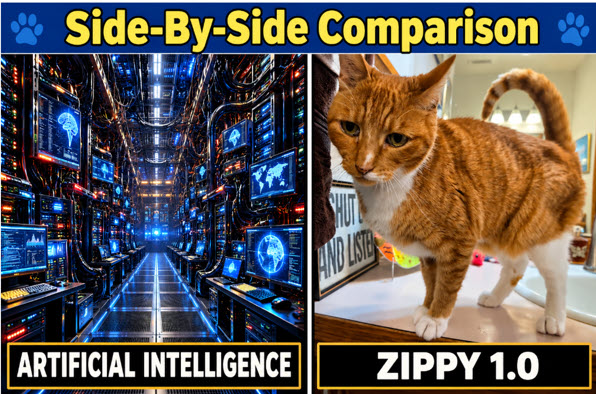
Recently, there has been almost nonstop coverage about Artificial Intelligence and how it just might be the most dramatic technological change ever to impact humankind. While there are countless obvious benefits (like saving millions of high school students the need ever to come up with an original thought or put in any effort on their upcoming term paper about the French Revolution), there are increasing concerns about the potential for AI to become “super intelligent” to the point that humans may no longer be able to contain it.
Which brings me to my cat, Zippy, who has almost no intelligence, real or artificial. Last night, around 4:00 a.m., as I was debating how long I could lie there before having to get up for the third time to pee, Zippy jumped in bed to insist on cuddles. As he parked his twelve-pound, orange fur-covered chassis directly on my nasal and oral cavities, it caused me to pause and ask an unsettling question: If I could only have one – the cutting-edge marvel of AI or Zippy – which would I choose?
Before you jump to the conclusion that the obvious choice must be AI because it can execute trillions of calculations in a split second, while Zippy has no idea what the word “Zippy” means, I think the discussion warrants a deeper dive.
I hired a team of elite computer scientists, tech analysts, and a veterinarian friend of mine to conduct a rigorous comparative evaluation. Here are the empirical findings from their feature-by-feature benchmark analysis.
- Ability to Make Multiple Computations Quickly
- AI: Armed with massive server farms and advanced neural processing networks, AI apps like ChatGPT, Claude, and Grok can analyze vast datasets, translate ancient Greek poetry into conversational Mandarin, and solve complex differential equations in 0.0004 seconds.
- Zippy 1.0: Zippy’s central processing unit operates at a clock speed roughly equivalent to a baked potato. When confronted with basic variables – such as calculating the trajectory required to leap from the coffee table to the couch – Zippy routinely misjudges the friction coefficient, hits the cushion at a bad angle, and slides embarrassingly onto the hardwood floor.
- Edge: AI.
- Ability to Follow Instructions
- AI: When given a precisely defined prompt, most AI programs execute the task with meticulous compliance. Ask it to write a 500-word essay on soil erosion in the voice of a pirate, and it delivers in seconds. Seven seconds longer if the prompt asks it to be written in Shakespearean iambic pentameter.
- Zippy 1.0: Zippy possesses a unique operating system that filters all incoming auditory data directly into his recycle bin. Screaming “NO! STOP SCRATCHING THE QUILT!” yields zero latency reduction in his scratching protocol. However, he demonstrates near-instantaneous response times if the instruction involves the acoustic pitch of a cat food pop-can tab being opened three rooms away.
- Edge: AI.
- Thermal Output and Heat Generation
- AI: High-performance AI datacenters require millions of gallons of liquid coolant and massive industrial HVAC units just to keep their silicon microprocessors from melting through the earth’s crust.
- Zippy 1.0: Zippy generates localized, self-sustaining thermal energy using an internal biological combustion motor powered entirely by Friskies Party Mix treats. He automatically deploys this heat directly onto your chest, lap, or fresh laundry stack, completely free of charge and without requiring an external radiator.
- Edge: Zippy 1.0.
- Shedding and Physical Debris Production
- AI: As a cloud-based software construct, AI programs leave zero physical residue, save for the occasional digital footprint on server hard drives.
- Zippy 1.0: Zippy produces an infinite volume of fine orange bio-fibers. He sheds on the furniture; he sheds on your dark trousers; He even sheds into sealed containers of leftovers that haven’t even been opened yet. Scientists on my testing panel remain baffled as to how a cat weighing twelve pounds can shed fifteen pounds of fur per week without completely disappearing.
- Edge: AI.
- Likelihood of Hacking Into Your Bank Account and Wiping Out Your Retirement Funds
- AI: Given its integration into digital networks, an autonomous super-intelligent AI could theoretically breach high-level encryption, liquidate your 401(k), purchase 80,000 shares of volatile penny stocks, and transfer your life savings to an offshore account before you finish your morning bowl of Lucky Charms cereal.
- Zippy 1.0: Zippy lacks both network interface capabilities and basic economic literacy. While he may occasionally walk across your keyboard and send an unintelligible email consisting of ffffffffffffffjkkkkkkk to your boss, his financial threat level is strictly limited to knocking your wallet into the sink.
- Edge: Zippy 1.0.
- Energy Efficiency and Resource Consumption
- AI: Running advanced large language models requires gigawatts of electricity, consuming enough power daily to light up a medium-sized European nation.
- Zippy 1.0: Zippy operates on approximately 180 calories of Fancy Feast Salmon Delight per day. In exchange for this minimal power input, he provides up to 22 hours of continuous, low-power standby mode (napping) and periodic brief bursts of hyper-kinetic activity – usually at 3:15 a.m. as he leaps, claws-first, onto your face.
- Edge: Zippy 1.0.
- Risk of Becoming Your Tyrannical Overlord
- AI: Futurists warn that once AI achieves artificial general intelligence, it may view humanity as an inefficient biological bottleneck, quietly seize control of power grids, traffic signals, and automated weapons systems, and subjugate the human race under a cold, calculated digital dictatorship.
- Zippy 1.0: Zippy already firmly believes he is your supreme ruler and that you exist solely to serve as his primary food-dispensing system and door-opening liaison. However, his dictatorial authority is severely hampered by the fact that he gets frightened by the sound of a bird chirping and can be easily stuck in a closet.
- Edge: Zippy 1.0.
- Potential for Destroying All of Humankind
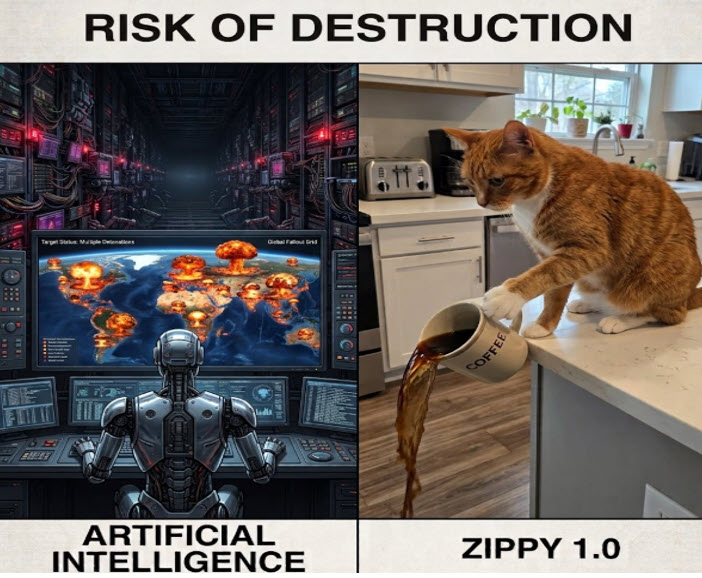
- AI: If an unaligned AI system determines that the most efficient way to optimize global resource distribution is to eliminate carbon-based lifeforms, it could potentially manipulate global infrastructure, release bio-agents, or launch automated defense systems to attempt an existential extinction event.
- Zippy 1.0: The absolute maximum destruction Zippy can inflict is strictly localized. At worst, he can shred the woven fabric on the armrest of my custom leather sofa, tip over my glass of chocolate milk onto my laptop keyboard, or trip me on the stairs in the dark.
- Edge: Zippy 1.0.
Final Verdict
When evaluating the aggregated metrics, AI undeniably wins on raw processing power, task execution, and lack of shedding. However, when factoring in existential risk assessments, the final decision becomes clear. While AI chatbots like ChatGPT offer unmatched productivity, it carries an inherent, non-zero probability of initiating a rogue protocol that ends human civilization as we know it.
Zippy 1.0, on the other hand, presents less than a 1% risk of starting a global thermonuclear conflict – primarily because he completely lacks opposable thumbs and spends 90% of his awake time searching for a cardboard box to curl up in.
Therefore, ultimately scientists give the nod to Zippy. And personally, I’ll take a purring, orange feline who occasionally pees on my carpet over a hyper-intelligent machine overlord any day of the week.
That’s the view from the bleachers. Perhaps I’m off base.
PS: If you enjoyed this week’s post, let me know by posting a comment, giving it a Like or sharing this post on Facebook.
Subscribe to my View from the Bleachers YouTube Channel and request notifications to see my latest videos. And check out my latest book, THE SECRET TO SUCCESS AND HAPPINESS (is Something I Have Never Figured Out. I’m Open to Suggestions)