
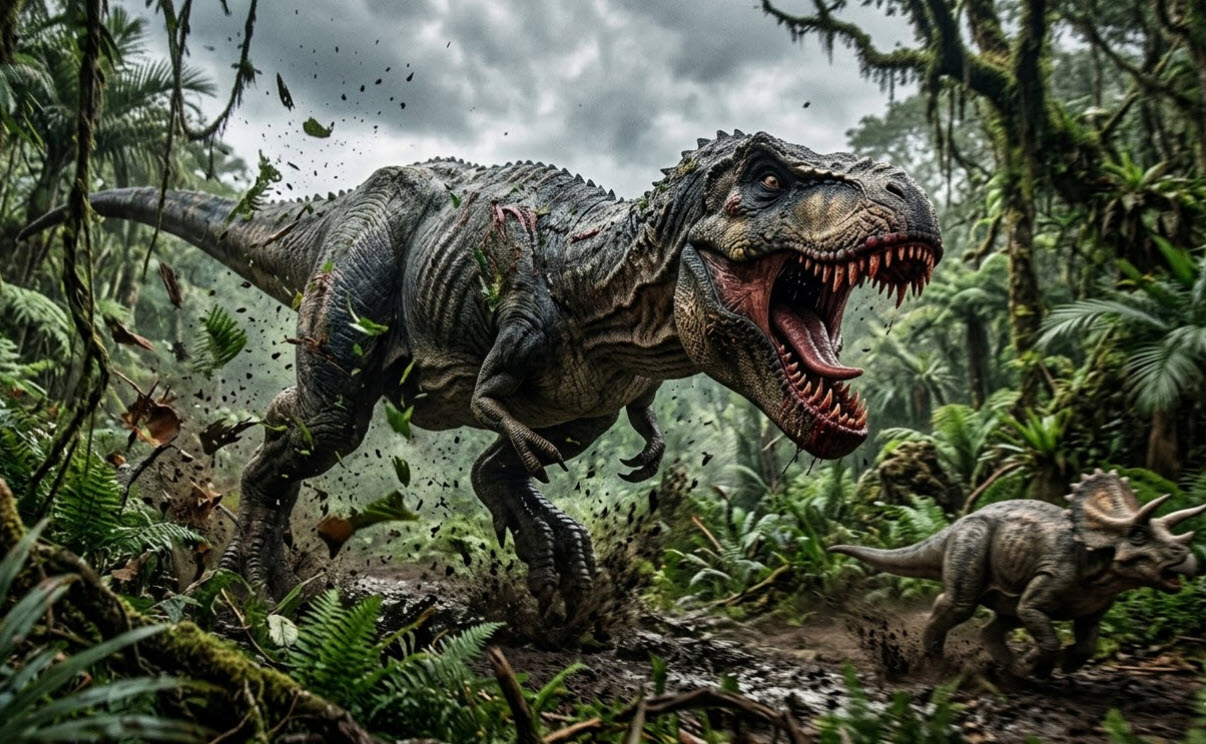
Tyrannosaurus Rex – “King of the Tyrant Lizards” – was perhaps the most ferocious dinosaur of all. With a bite force of up to 6 tons—strong enough to crush cars—and over 50 banana-sized teeth, he was a terrifying predator. But you should have seen him try to eat spaghetti, with those spindly little front legs. Pathetic.
I recently watched a fascinating four-part dinosaur documentary on Netflix produced by Steven Spielberg. Giant creatures, epic landscapes, dramatic narration by Morgan Freeman, and lots of computer-generated reptiles stomping around looking extremely confident about their place in the food chain – right up until the moment a giant space rock decided to cancel their subscription to “Living.”
I’m a bit of an amateur paleontologist myself. (I once found what I believe was a fossilized chicken wing behind a Buffalo Wild Wings, though the manager insisted it was just “from Tuesday.”) So, I decided to dig a little deeper into dinosaur history.
After hours of intensive research, which included documentaries, Wikipedia, and a rather suspicious Reddit thread authored by someone named PrehistoricPete420, I uncovered several astonishing findings that scientists have been strangely reluctant to publish. Until now.
Here are nine surprising dinosaur facts you probably never knew.
- Dinosaurs once lived in Antarctica.
Yes – Antarctica. Today the continent is a frozen wasteland where the only residents are penguins, research scientists, and the occasional documentary film crew wearing parkas the size of camping tents.
But millions of years ago, Antarctica had forests, rivers, and enough vegetation to support dinosaurs. Imagine being a massive sauropod strolling through lush Antarctic ferns, totally unaware that in the future the same location would host graduate students studying ice cores while questioning every life decision that brought them there. It’s a reminder that real estate values can change significantly over 100 million years.
- Dinosaurs were surprisingly responsible parents.
Evidence suggests many dinosaurs cared for their young by building nests and protecting eggs. Imagine that prehistoric parents likely experienced many of the same daily parenting struggles as modern humans:
- Kids refusing to eat their prehistoric vegetables.
- Kids fighting over who got to sit on the “good” rock. (That’s prehistoric for “riding shotgun”.)
- Kids asking “Are we there yet?” during long migrations across Pangea.
Except in this case, the children weighed three tons and had claws that could slice a Toyota Prius in half.
- Their brains were… well, “compact.”
We’ve all heard that the Stegosaurus had a brain the size of a walnut. While that’s a bit of an exaggeration (it was more like a lime), it does explain a lot. If your brain is the size of a citrus fruit and your body is the size of a city bus, you aren’t spending your afternoons solving Wordle or pondering the existential dread of the Mesozoic Era. You are mostly focused on two things: “Is that a bush?” and “Can I eat it?” It was a simpler time.
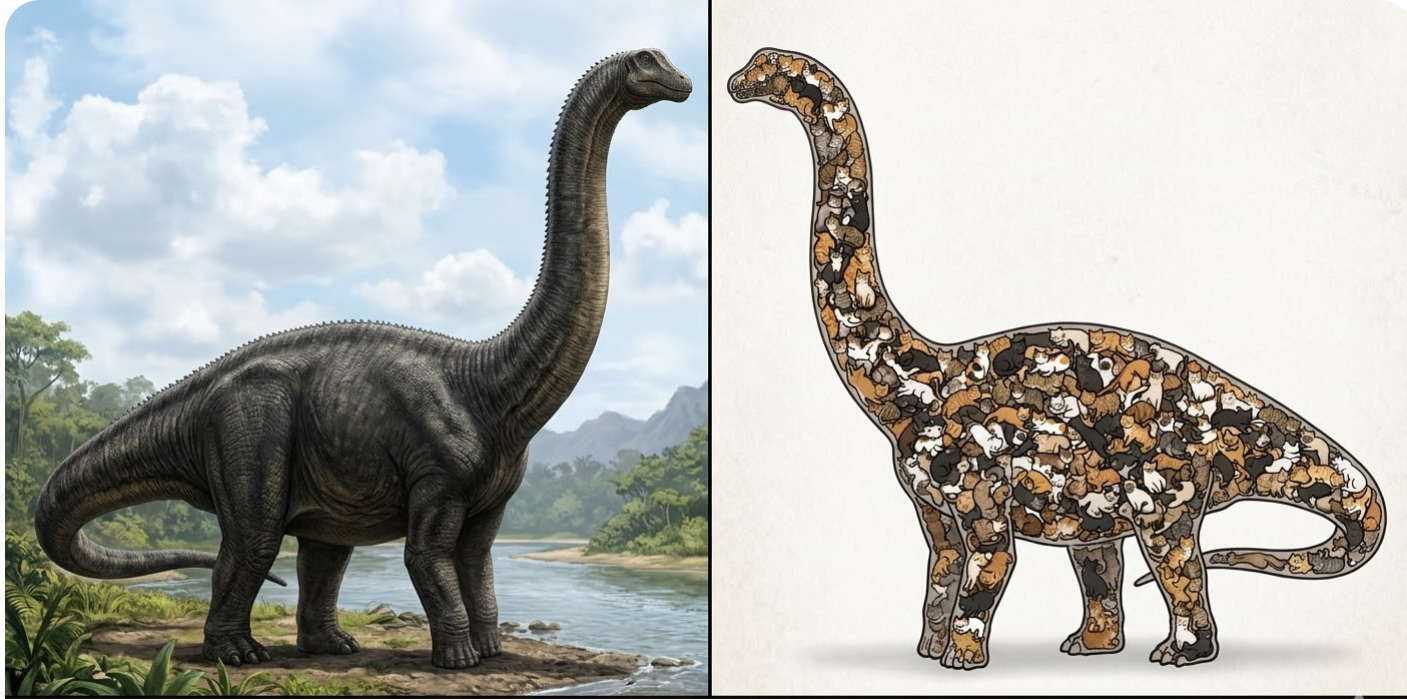
At left: The Argentinosaurus – one of the largest creatures ever to walk the earth. He was so large, it would take roughly 20,000 housecats to equal his weight. At right: an artist’s conception of what that might look like.
- Dinosaurs had “Fashion Trends” (mostly feathers).
For decades, we thought dinosaurs were scaly, like giant crocodiles. Now, paleontologists believe many of them – including T-Rex – actually had feathers. This changes everything. Instead of a terrifying, leather-skinned monster, the T-Rex might have looked like a 40-foot-tall, angry chicken with a bad attitude. It’s much harder to be intimidated by a predator when it looks like it’s sashaying in a feather boa. “Look out! Here comes the King of the Lizards… and he looks FABULOUS!”
- The asteroid didn’t kill every dinosaur instantly.
When the famous asteroid struck the Earth near what is now the Yucatán Peninsula, it caused catastrophic climate disruption. But contrary to popular belief, not every dinosaur vanished instantly in a Michael Bay-style explosion.
Some survived weeks or even months before finally succumbing to collapsing ecosystems and what scientists describe as “a truly toxic job market.” With the sun blocked by dust, the price of basic groceries skyrocketed. Kale became a luxury item. Wine prices were particularly brutal, which is a tragedy because if ever there was a time a dinosaur needed a stiff Pinot Grigio, it was during a global firestorm extinction event.
- Dinosaurs could roar, but they probably couldn’t talk.
Despite several beloved children’s movies in which dinosaurs hold full conversations about their feelings and the importance of teamwork, most scientists agree that dinosaurs lacked the vocal structures for articulate speech.
A hungry Allosaurus probably could not say: “Excuse me, Mr. Stegosaurus, but you look absolutely delicious today. Is that a hint of wild fern I smell on your breath?” Instead, it likely communicated something closer to: “RRRRAAAAAAWWWWWR.” Which, to be fair, gets the point across equally effectively – and with significantly less small talk.
- Most dinosaurs were terrible at math.
Based on my research, it is highly unlikely that the average dinosaur could count past the number three, mostly because they lacked fingers and spent most of their cognitive energy trying to put one foot in front of the other.
Imagine a peaceful herd of grazing hadrosaurs looking up to see a pack of Tyrannosaurus Rexes charging toward them. One hadrosaur squints into the distance.
“Hmm. One T-Rex… two T-Rexes… three T-Rexes…” Long pause. “…well, this seems manageable.”
Moments later, the herd realizes there are actually twelve T-Rexes, at which point the final thought recorded in the fossil record was: “Uh oh! Oh, no! …We’re so screwed!” (Or words to that effect, likely involving a lot of terrified squawking).
- There is no credible evidence dinosaurs used cutlery.
Most dinosaurs simply ground their food with their teeth, skipping entirely the evolutionary step involving forks, knives, and salad tongs. This made dinner parties incredibly efficient but very hard on the upholstery.
There was one excavation in eastern China in the early 1990s that briefly caused excitement when researchers discovered what looked like primitive chopsticks near a Triceratops skeleton. Some experts speculated this might prove that Triceratops had developed an early utensil culture. Unfortunately, the theory collapsed when investigators noticed the chopsticks had the words “Panda Express” printed on the side and a coupon for a free Spring Roll. Science can be cruel that way.
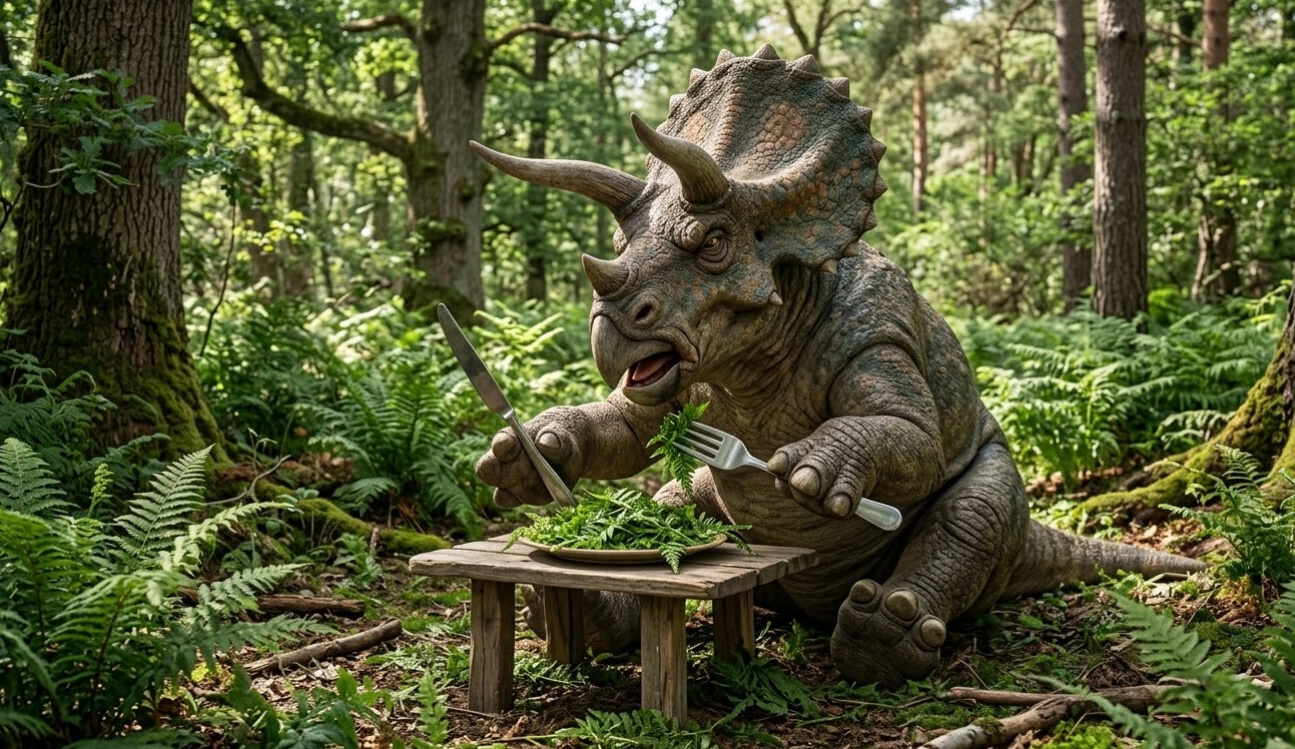
Could the Triceratops actually eat with cutlery, as some researchers have speculated? Um, no. Those researchers are idiots. Forks and knives didn’t exist way back then. That said, Triceratops were extremely adept at foraging and – now this may surprise you – quilting. Science is amazing!
- If the asteroid had missed, dinosaurs might still rule the world.
This is the truly mind-bending thought. If that asteroid had sailed harmlessly past Earth, dinosaurs might still dominate our planet. Picture it: Dinosaur governments. Dinosaur corporate retreats. Dinosaur traffic jams where the “honking” is just literal 110-decibel bellows.
Would they have eventually invented smartphones? Probably not. We may never know.
But one thing seems likely: Very few dinosaurs would have subscribed to my humor column. Not because they lacked the intellect [my humor column doesn’t require much of that]. No, it’s because observational humor about the annoying neighbors and airline food simply doesn’t land the same when your average day involves eating 400 pounds of raw ferns or being chased by a creature with teeth the size of foot-long Ginsu steak knives.
Some audiences are just hard to reach – especially when they’ve been extinct for 66 million years.
That’s the view from the bleachers. Perhaps I’m off base.
 PS: If you enjoyed this week’s post, let me know by posting a comment, giving it a Like or sharing this post on Facebook.
Subscribe to my View from the Bleachers YouTube Channel and request notifications to see my latest videos. And check out my latest book, THE SECRET TO SUCCESS AND HAPPINESS (is Something I Have Never Figured Out. I’m Open to Suggestions).









Hi Tim,
I have always loved learning about dinosaurs. As a Kg teacher we had learning units of dinosaurs . One day I was mentioning the Diplodocus, and I pronounced it DiplO -docus. Little 5 year old Clay, hesitantly said that I said it wrong and he corrected me….”Uh , Mrs B, I think you say it — Diplodocus. How to feel small in a group of 5 year olds!!!
Alice Blueglass
I